Blank sheets when there's still toner in the machine. A grinding sound nobody can place. A print job that leaves your computer and never reaches the tray. This page covers the Ricoh problems that don't come with a clear error message, and how to figure out what's really going on.
Some Ricoh problems are common enough to have their own step-by-step guide. If yours is one of these, head straight there:
Everything else is here: blank or poor-quality prints, odd mechanical noises, jobs that quietly disappear, paper and originals that won't feed, and scanning setups that suddenly stop working.
One thing to know before you start. Most Ricoh office printers and multifunction copiers are laser machines that print with toner, not ink, so the steps below are written for toner models. If you have a Ricoh GelSprinter (the SG series), which uses gel ink and a print head, the FAQ at the bottom covers print head cleaning.
Printer Tales is an independent troubleshooting resource and isn't affiliated with Ricoh. If your machine is leased or covered by a service agreement, check with your dealer before opening internal covers, since hardware repairs may already be included.
Start Here: Print a Configuration Page
Before you change a single setting, print a configuration page directly from the printer's control panel. It's the quickest way to find out which side of the problem you're on.
- Older MP and SP models with a User Tools key: press User Tools, then choose Printer Features, List/Test Print, and Config. Page.
- IM series models with the large touch screen: open Settings, then Machine Features Settings, Printer Settings, the List/Test Print tab, and Configuration Page.
If the page prints cleanly, the printer's hardware is working, and the problem sits somewhere between your computer and the machine. If it comes out blank, faded, streaked, or doesn't print at all, the problem is inside the printer.
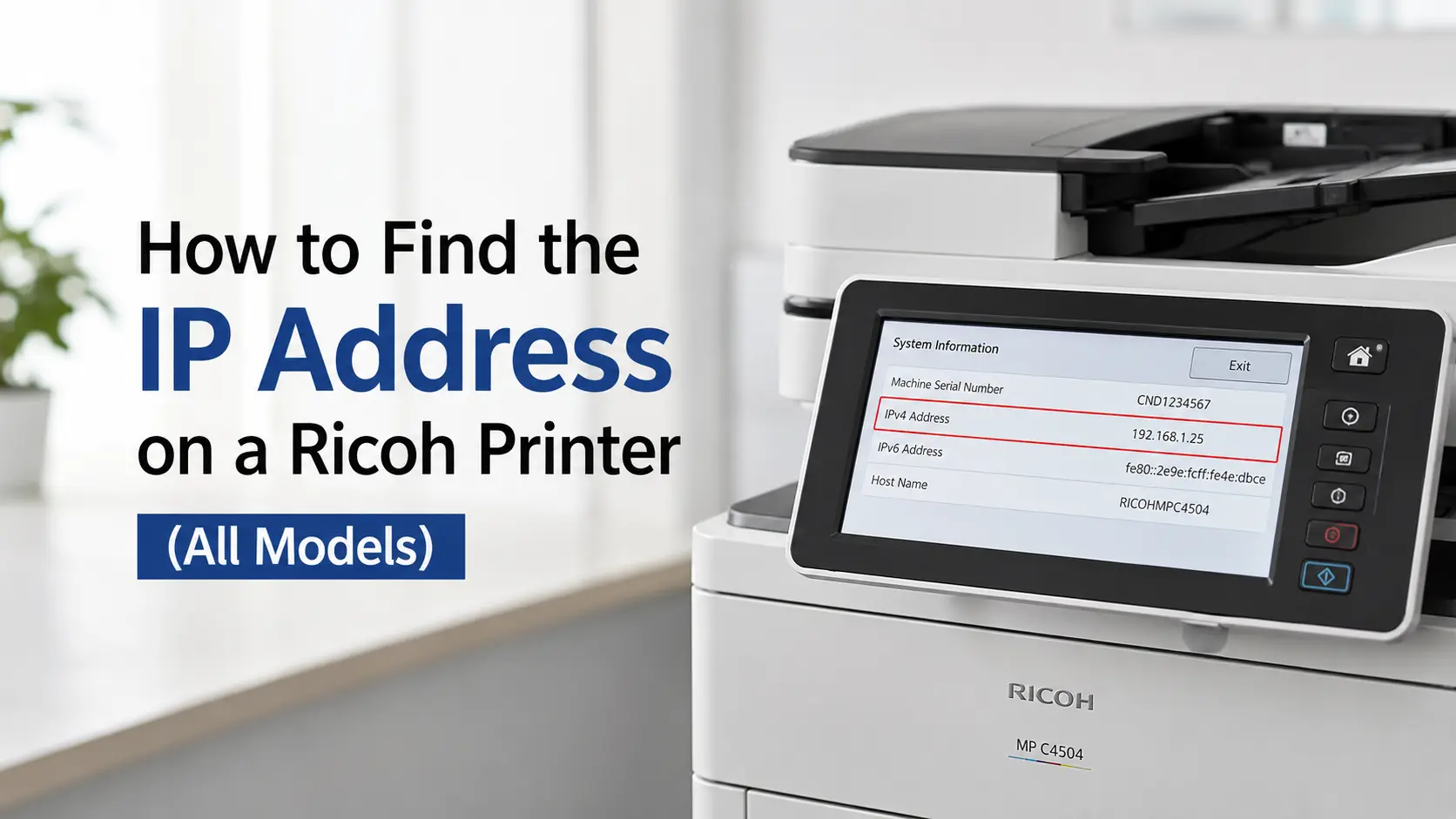
Hang on to that page either way. It shows the printer's IP address, firmware version, tray settings, and page counter, and you'll likely need at least one of them further down. Menu labels shift a little from model to model, so if yours don't match exactly, look for "List/Test Print" in the printer settings.
When Your Ricoh Prints Blank Pages
A completely blank page means one of two things. Either the printer never received usable page data, or it got the job and couldn't put toner on the paper. Your configuration page already told you which.
If the configuration page came out blank too, check the toner side:
- Look for a leftover seal. New Ricoh cartridges ship with protective tape or a seal. If the blank pages started right after you installed a cartridge, take it back out and make sure all the packing material is gone.
- Reseat the cartridge. Many desktop Ricoh models call it a print cartridge. Pull it out, then push it back in until it stops and settles into place. If your model's instructions call for it, give a new cartridge a few gentle side-to-side shakes before installing it.
- Read the panel. An empty cartridge doesn't always stop the printer right away, especially if someone tapped past the replacement warning. If the display shows a replacement message for any cartridge, swap it.
- Check the drum. On models with a separate photoconductor unit, a worn one can cause faint or blank output. Replace it if the panel says it's due.
If the configuration page printed fine, look at the job instead:
- Check the file itself. Spreadsheets and documents with stray page breaks or empty rows at the end often send blank sheets along with the real pages.
- Print from a different program. If a PDF comes out blank from a web browser but prints fine from a PDF reader, the problem is the browser's viewer, not the printer.
- Confirm the driver matches your model. A generic Windows driver, or a driver for a different Ricoh model, can produce blank pages or pages full of random characters. Our Ricoh printer driver guide shows how to install the right one.
Faded, Streaky, or Smudged Prints
On a Ricoh laser, print quality problems nearly always come down to four things: toner, the drum, the paper, or the fuser. What the page looks like tells you where to start.
- Everything looks light or washed out. Check whether toner saving is turned on, in the printer driver or on the panel. It's easy to forget someone enabled it. After that, check the toner level and replace a low cartridge.
- Prints turn blurry right after the printer was moved, or on a cold morning. Condensation forms inside the machine when it goes from cold to warm. Leave it switched on in the room for a while before printing. Damp paper causes the same blurring, so load a fresh ream from a sealed package. Some models also have an Anti-Humidity setting you can raise.
- White streaks run down the page. Suspect low toner or damp paper first. If neither is the cause, a dirty registration roller is next, and on a high-mileage machine the photoconductor unit may be worn out.
- Toner smears or rubs off under your thumb. The toner isn't being fused to the paper. Make sure the paper type set for that tray matches what's loaded, especially with heavy stock, labels, or card stock. If the setting is right and smudging continues, the fusing unit is wearing out. On many Ricoh models it's replaced as part of a maintenance kit.
- Colors look shifted or outlined on a color model. Run Color Registration from the printer's adjustment or maintenance menu.
A quick safety note: the fuser gets hot enough to burn. If you open the printer to look inside, turn it off and give it time to cool first.
Strange Noises Coming From Your Ricoh
Before assuming something broke, know that Ricoh machines make plenty of noise on purpose. Color models run automatic image quality adjustments after a set amount of time or a certain number of pages, and a full adjustment can keep motors turning for several minutes while nothing prints. Cooling fans often keep going after a large job. A few loud noises on the first power-up after certain parts are replaced are normal too.
The sounds worth chasing down are the new ones: noise that repeats with every page, gets louder over the weeks, or shows up alongside an error.
- Notice when it happens. Noise at power-on or while idle is usually an adjustment cycle. Noise only while paper is moving points to the feed path. Noise only during copies and scans points to the scanner or document feeder.
- Check the paper path. Turn the printer off, open the covers you'd normally open for a jam, and look for torn scraps, a staple, a paper clip, or a label that peeled off its backing. Small debris is behind most new grinding or ticking sounds.
- Pull every paper tray out. A sheet that slid over the back of a tray can rub the feed rollers each time they turn.
- Reseat the toner cartridges and drum unit. A part that isn't fully locked in can rattle or knock during printing.
- Make sure the printer sits level. A machine on an uneven stand or a wobbly table vibrates more and is louder.
If the noise continues with the covers closed and the paper path clear, worn gears, rollers, or bearings are the likely source, and that's a service repair. Print as little as you can until it's looked at, because a grinding part rarely fixes itself.
If your Ricoh simply runs louder than you'd like, some newer models offer a silent mode that lowers operating noise in exchange for slower printing, copying, and scanning.
Print Jobs Disappear or Never Print, With No Error
You click Print, the job leaves the queue on your computer, and nothing comes out. No error on the panel, nothing on your screen. On a Ricoh multifunction printer, that usually means the machine is doing exactly what it was set up to do.
The job is being held at the printer. Ricoh drivers can send a job as Hold Print, Locked Print, or Stored Print instead of a normal print. Those jobs wait on the machine until someone releases them. At the control panel, open the Printer function, tap Print Jobs, and check the held or locked job list. A Locked Print job asks for the password entered in the driver when it was sent. To stop jobs from being held, open Printing Preferences on your computer and set the job type back to Normal Print.
The printer needs a user code. Many offices turn on user code authentication to track who prints what. When a job arrives without a valid code, the printer cancels it, and the only clue may be a brief notice on the panel that's gone before you walk over. Enter your assigned user code in the driver's settings. If you don't know it, your office's printer admin or copier dealer can give it to you.
The printer's IP address changed. When a router hands the printer a new address, your computer keeps sending jobs to the old one. Find the current IP on your configuration page. Then, in Windows, open the printer's properties, go to the Ports tab, and update the Standard TCP/IP port to the new address. Setting a fixed IP address on the printer, or a reserved address in your router, keeps it from happening again. While you're in there, look for a duplicate copy of the printer using a WSD port. Windows sometimes adds one on its own, and it tends to work one day and fail the next.
If the printer shows as offline or rejects every job, our guides for a Ricoh printer offline and a Ricoh print job stuck in the queue go further.
Paper or Originals Won't Feed
This section covers feed problems where nothing is actually stuck inside. If there's paper jammed in the machine, use our Ricoh paper jam guide instead.
Paper Trays and the Bypass Tray
- Set the paper guides snug against the stack. Loose guides let sheets feed crooked. Guides pushed too tight bow the paper so the rollers can't grab it.
- Stay below the fill line. An overloaded tray is one of the most common reasons for misfeeds and sheets feeding two at a time.
- Fan the paper before loading. Riffle the edges, then tap the stack square on a flat surface so the sheets separate.
- Flatten curled paper. Ricoh recommends keeping curl to about 2 mm (0.08 inch). Paper left out in a humid room often curls more than that.
- Match the tray setting to the paper. A tray set for plain paper that's loaded with card stock can misfeed or trigger a paper mismatch message.
- Keep rough or textured stock out of the bypass tray. High-friction paper tends to double feed from the bypass tray. Load it into a standard tray instead.
- Tray missing from your print options? If Tray 2, Tray 3, or the bypass tray doesn't appear in the print dialog, open the printer's properties on your computer and enable it on the Accessories tab.
The Automatic Document Feeder (ADF)
When the feeder on top of a copier won't pull originals in, grabs several at once, or feeds them at an angle, dirty rollers are usually to blame. Toner dust and paper fibers coat the rubber until it loses its grip.
- Turn the machine off and unplug it.
- Hold the feeder steady and lift the ADF cover slowly.
- Wipe the feed rollers with a soft cloth dampened with water and wrung out well. On many models you can lift the paper feed roller out so you can clean it all the way around.
- Wipe the separation pad, sometimes called the friction pad, with the same damp cloth.
- Let everything dry, put the roller back, and close the cover by pressing gently at the center.
Check the originals too. Staples, sticky notes, torn edges, and very thin or glossy pages cause a lot of ADF misfeeds, so scan fragile pages one at a time on the glass. If a freshly cleaned feeder still misfeeds on ordinary office paper, the rollers are probably worn and need replacing.
Scan to Folder or Scan to Email Stopped Working
When scanning worked for months and then stopped without anyone touching the printer, the cause is almost always on the receiving end: a Windows update, a changed password, or a new security rule from your email provider.
Scan to Folder
- Check the saved password first. Scan to folder signs in to the destination computer with a stored username and password. If that person changed their Windows password, the printer is still trying the old one. Update it in the printer's address book entry for that folder.
- Check the SMB version. Current versions of Windows don't use SMB 1.0 by default, and older Ricoh machines that depend on it can't reach the folder. Ricoh released firmware that adds SMB 2 and SMB 3 support for many models, so a firmware update is the better fix. Turning SMB 1.0 back on in Windows Features also works, but it's an outdated protocol with known security weaknesses, so only do it with your IT team's approval.
- Watch for Windows 11 version 24H2. That release requires SMB signing by default and blocks guest access on Pro editions. A scan folder shared without a password, or an older Ricoh that can't handle the new requirements, may stop working after the update. Sharing the folder through a real user account and updating the printer's firmware is safer than loosening Windows security settings.
- Check permissions and security software. The account the printer uses needs permission to write to the shared folder, and a firewall or antivirus program on that computer can block the connection.
If scan to folder still won't cooperate, Ricoh's suggested alternatives include scanning to email, scanning to FTP, or saving scans to the machine's Document Server and downloading them through Web Image Monitor.
Scan to Email
- Microsoft 365 or Exchange Online. Microsoft is retiring basic authentication (a plain username and password) for sending mail through SMTP AUTH. Under its current schedule, basic authentication will be turned off by default at the end of December 2026. Admins can switch it back on for now, until Microsoft announces a final removal date in the second half of 2027. The long-term fix is OAuth 2.0, which many current Ricoh models support with the right firmware. It uses smtp.office365.com on port 587 with STARTTLS, and a Microsoft 365 admin has to approve the connection.
- Gmail or Google Workspace. Google no longer accepts a regular account password from devices like scanners. Turn on 2-Step Verification and create an app password for the printer, or have your Workspace admin set up Google's SMTP relay service.
Resetting the Windows Print Spooler
The Print Spooler is the Windows service that lines up print jobs and passes them to the printer. When it hangs, jobs pile up in the queue, the printer looks perfectly healthy, and nothing prints from any program. Resetting it takes a couple of minutes.
- Press Windows + R, type
services.msc, and press Enter. - Find Print Spooler, right-click it, and choose Stop.
- Press Windows + R again, type
%WINDIR%\System32\spool\PRINTERS, and press Enter. Delete everything inside that folder, but leave the folder itself. Click Continue if Windows asks for administrator permission. - Back in Services, right-click Print Spooler and choose Start.
- Double-click Print Spooler and make sure Startup type is set to Automatic so it starts on its own after a reboot.
- Send one test page.
Clearing that folder cancels every waiting job on that computer, so give anyone in the middle of printing a heads-up.
If the spooler keeps stopping on its own, a damaged or mismatched driver is usually behind it. Removing the printer and installing the correct Ricoh driver for your model is the standard fix.