Connect your Ricoh printer or office MFP to Wi-Fi using WPS, manual setup, Web Image Monitor, or a direct connection, and fix the printers that connect but still won't print.
When a Ricoh printer refuses to join Wi-Fi, the cause is usually more specific than a bad signal. Ricoh makes two very different kinds of machines. Compact SP and P series printers have Wi-Fi built in. Office multifunction printers, like the IM and MP series, treat wireless as an add-on board that has to be installed and turned on. What you need to do depends on which one is sitting in front of you.
This guide starts with the checks that take a minute, explains what's really blocking the connection, then walks through four ways to connect. The last section is for the frustrating case where the printer says it's connected and your print jobs still go nowhere.
Quick Checks Before You Change Any Settings
Go through these first. Each one takes a minute or less, and any of them can be the whole problem.
- Confirm the printer supports Wi-Fi. Compact Ricoh models with built-in wireless usually have a "w" at the end of the name, such as the SP C261SFNw or SP 230DNw. Office MFPs such as the IM C3000 need Ricoh's optional wireless LAN board. Without that board, nothing on the screen will get the machine online wirelessly.
- Pull out the network cable. On many Ricoh models, the wired port wins when both are available, and on some the two can't run at the same time. An Ethernet cable left plugged into the back is a common reason Wi-Fi setup seems to do nothing.
- Make sure wireless is actually on. Compact printers have a Wi-Fi enable setting under Network Settings that can be switched off. On office MFPs, the LAN Type setting has to say Wireless LAN, not Ethernet.
- Check the network name for odd characters. Ricoh printers accept network names (SSIDs) of up to 32 standard keyboard characters. If your Wi-Fi name has an emoji or accented letter in it, the printer won't be able to match it.
- Get the password from the source. Both the network name and password are case sensitive. Read them off the router label or from a device that's already connected rather than typing from memory.
- Restart in the right order. Turn off the printer, restart the router and wait until its lights settle, then turn the printer back on. Large MFPs can take a couple of minutes to fully boot, so let the home screen load completely before you test.
Why Your Ricoh Printer Won't Connect to Wi-Fi
Once you know which of these applies, the right fix is usually obvious.
- Wireless is missing or disabled. An office MFP without the wireless LAN board, or with LAN Type still set to Ethernet, will never look for a network.
- Ethernet is taking over. With a cable connected, many Ricoh models ignore their wireless connection completely.
- The network changed. A new router, a switch to a different internet provider, or a new Wi-Fi password leaves the printer trying to log in with details that don't work anymore. This is the most likely cause if the printer worked fine until recently.
- The band doesn't match. Compact Ricoh printers built around 802.11b/g/n wireless should be set up on 2.4 GHz. Some of Ricoh's wireless boards for office machines also support 5 GHz, but a router that merges both bands under one name can still trip the printer up.
- The router's security is too new. The wireless setup in Ricoh's guides for popular IM series models offers WEP and WPA2 options. If your router is set to WPA3 only, a printer like that may never finish connecting.
- The office network needs a login. Business networks that use IEEE 802.1X, where you connect with a username or a certificate instead of one shared password, need extra setup on the printer. That's usually a job for IT, done through Web Image Monitor.
- The signal is too weak. Copiers tend to end up in back offices and supply rooms, far from the nearest access point. Ricoh lets you check signal strength right from the control panel (covered below).
- The IP address moved. The printer is on Wi-Fi, but your computer is still sending jobs to the address it had last week.
How to Connect Your Ricoh Printer to Wi-Fi
Use Method 1 if your router has a WPS button and it's turned on. Use Method 2 for the most dependable setup on almost any model. Method 3 is for office MFPs you'd rather configure from a desk, and Method 4 is for printing when there's no usable router at all.
Method 1: Connect Using WPS (Push Button or PIN)
WPS lets the router pass its Wi-Fi details to the printer, so you don't type a password on the printer. Ricoh supports both the push-button and PIN versions.
Push button
- On the printer, open the wireless setup menu. On MFPs with the Smart Operation Panel, go to Settings > System Settings > Network/Interface > Machine: Wireless LAN. On compact models, press User Tools and open Network Settings.
- Choose the WPS option, then Push Button.
- Within two minutes, press the WPS button on your router. Some routers need the button held for a few seconds, so check the label or manual.
- Wait for the printer to confirm the connection, then check that it shows an IP address in its network settings.
PIN code
- In the same WPS menu, choose PIN. The printer displays an 8-digit code. Write it down before you move on.
- On a computer that's already connected to the router, open the router's admin page in a browser and find its WPS section.
- Enter the printer's PIN there and start WPS from the router's page.
- Go back to the printer and press Connect. On compact models, the screen tells you to wait up to two minutes while it links up.
If WPS times out every time, your router may have it turned off. Many routers ship that way for security reasons. Skip ahead to Method 2.
Method 2: Set Up Wireless LAN Manually from the Control Panel
Manual setup takes a few extra minutes, but you pick the exact network and enter the key yourself, so there's less that can go wrong. This is "Infrastructure Mode," which just means the printer connects through your router or access point.
Office MFPs with the Smart Operation Panel (IM series)
- Press Home, then tap Settings.
- Go to System Settings > Network/Interface > Machine: Wireless LAN. If your machine uses the classic screen layout, the path is Settings > Machine Features Settings > System Settings > Interface Settings > Wireless LAN.
- Confirm LAN Type is set to Wireless LAN.
- Set Communication Mode to Infrastructure Mode.
- Search for nearby access points and select your network. If your network is hidden, type the SSID in manually.
- Choose the security method that matches your router. Most home and small office routers use WPA2-PSK. Enter the encryption key (your Wi-Fi password).
- Save the settings and restart the machine if it asks you to.
- Open the wireless menu again and press Wireless LAN Signal to confirm the printer is picking up a usable signal.
One catch: if you're using the first-time setup wizard under Basic Settings When Installing and your network uses WPA2 with a login server (not a shared password), the wizard can't finish the job. Use the System Settings path above instead.
Compact SP and P series printers
- Press User Tools on the control panel.
- Scroll to Network Settings and press OK.
- Make sure Wi-Fi is enabled. Some models ask you to confirm with OK and then restart.
- Open the Wi-Fi setup option (called the Wi-Fi Setup Wizard on many models) and select your network from the list.
- Enter the Wi-Fi password and confirm.
- Wait for the printer to report a connection, then check its network info for an IP address.
Method 3: Configure Wi-Fi Through Web Image Monitor
Web Image Monitor is the browser-based settings page built into Ricoh printers. It's the easier route for office MFPs, since typing a long Wi-Fi key on a copier screen gets tedious fast. Your computer has to reach the printer first, which usually means leaving it on Ethernet while you set up wireless.
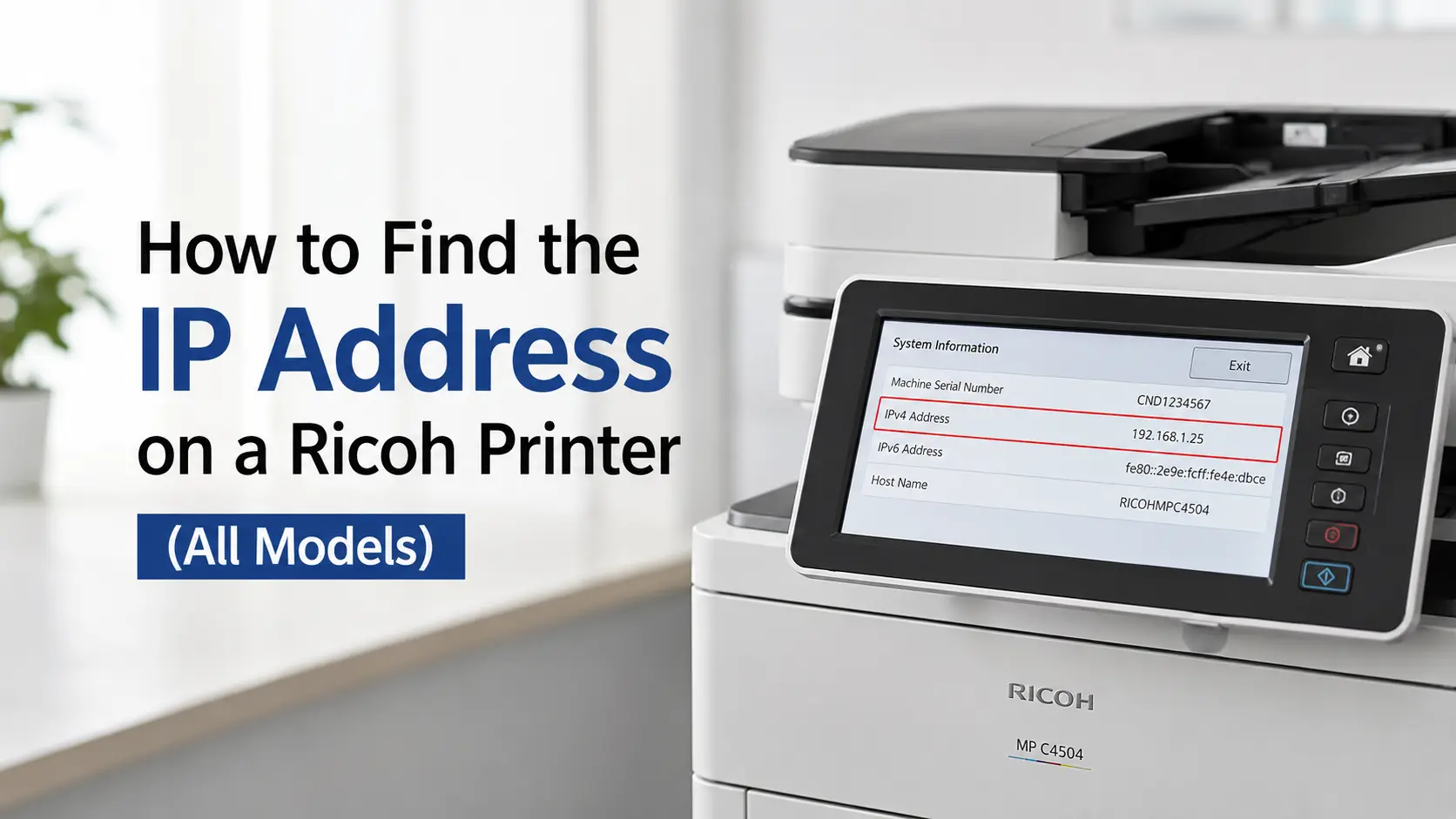
- Find the printer's current IP address by printing a Configuration Page or checking its network settings on the control panel.
- On a computer on the same network, type http:// followed by that IP address into your browser's address bar.
- Click Login and sign in with an administrator account. If your company changed the admin login, your IT team will have it.
- Go to Device Management > Configuration and open the Wireless LAN settings.
- Set Communication Mode to Infrastructure Mode, enter the SSID, choose the security method, and type the key. This is also where IT sets up 802.1X for company networks that require it.
- Apply the changes, set LAN Type to Wireless LAN if your model has that setting, and unplug the Ethernet cable.
- Print a new Configuration Page. The printer will probably have a different IP address on Wi-Fi than it had on the cable, and you'll need the new one for your computers.
Method 4: Connect Directly Without a Router (Wi-Fi Direct or Ad-hoc Mode)
A direct connection skips your network entirely. It's useful when the router is down, when there's no Wi-Fi where the printer sits, or when someone just needs to print from a phone. The trade-off is that only the connected devices can print. Other computers on your network still won't see the printer.
Wi-Fi Direct (phones and tablets)
- On the printer's control panel, open Wireless LAN: Easy Setup / Direct Connection.
- If your Android device supports it, press Connect under Push Button, then start Wi-Fi Direct on the phone. Other Android devices and iPhones use the PIN method instead.
- To connect manually, look up the printer's network name and password under Machine: Wireless LAN > Direct Connection Mode > Direct Connection Settings. The network name starts with DIRECT-. Select it in your phone's Wi-Fi list and enter the password.
- Print from Ricoh's free RICOH Smart Device Connector app, available for iOS and Android.
On IM series machines, Group Owner Mode lets several devices connect at once: up to four through the Smart Operation Panel, or up to nine with the optional wireless LAN board installed.
Ad-hoc Mode (a single computer)
Ad-hoc Mode links one computer straight to the printer. It needs the optional wireless LAN board, and it can't be combined with a wired network connection.
- Go to the Wireless LAN settings from Method 2 and set Communication Mode to Ad-hoc Mode.
- Enter a network name (SSID) for the connection.
- Choose a channel from 1 to 11. If the connection turns out slow or unstable, try a different channel.
- Set security to WEP and enter a key. WEP is the only option Ricoh offers in this mode.
- On the computer, join the network name you just created and enter the same key.
WEP is an old, weak form of encryption. Use Ad-hoc Mode as a short-term workaround, not as your permanent setup.
Printer Connected to Wi-Fi but Still Not Printing?
If the printer shows a wireless connection and your jobs still fail, the problem has moved from the printer to the path between your computer and the printer. Work through these in order.
Match the IP address. Print a Configuration Page and note the printer's IP address. In Windows, open the printer's Printer properties and check the Ports tab. If the port points to an old address, update it, or remove the printer and add it again. To stop this from happening after the next router restart, reserve that IP for the printer in your router's DHCP settings, or give the printer a fixed address in its own network settings.
Check the signal, not just the connection. A printer can technically connect with a signal too weak to handle a full print job. Press Wireless LAN Signal in the wireless menu. If the reading is poor, move the printer closer to an access point or add one near the copy room.
Give 2.4 GHz its own network name. If your router broadcasts one name for both bands, split them, or turn off the router's band steering or "smart connect" option. Then connect the printer to the 2.4 GHz network by name.
Take the router out of WPA3-only mode. Switch security to the WPA2/WPA3 mixed setting (some routers call it transition mode). Newer phones and laptops keep using WPA3, and older printers can still join with WPA2.
Look for router filters. If your router uses MAC address filtering, add the printer's MAC address to the allowed list. You'll find it on the Configuration Page. Also keep the printer off guest networks, since those usually block devices from talking to each other.
Update the driver. A driver installed for a USB or wired connection won't always find the printer on Wi-Fi. Our Ricoh printer driver guide covers a clean reinstall step by step.
Ask about firmware. Ricoh publishes firmware updates that can improve network behavior. On leased office machines, your Ricoh dealer or service provider typically handles firmware, so contact them before updating it yourself.
Reset network settings as a last step. Resetting the network settings and running Method 2 again clears out bad saved values. On an office MFP, check with IT first, because a reset also erases the fixed IP address and other network settings your company may rely on.
If the printer keeps dropping off after all of this, our guide to fixing a Ricoh printer that shows offline goes deeper into the computer side of the problem.