Nothing stalls a print job like a cryptic code or a wall of blinking lights where your document should be. The frustrating part is that Epson doesn't use one universal system, so the same letter or number can mean something different depending on which printer sits on your desk. This page walks through how Epson printers actually communicate a problem, decodes the messages you're most likely to see, and tells you plainly which ones you can clear yourself and which ones mean it's time to stop troubleshooting and need additional help.
How Epson Printers Actually Show You a Problem
Depending on your model, an Epson printer will flag a problem in one of three ways:
A written message on an LCD screen. Printers with a full display, common across the Expression and WorkForce lines, spell it out directly: "Printer is Offline," "Replace Maintenance Box," or the more alarming "A printer error has occurred."
A short alphanumeric code. Many of those same screens pair the message with a code such as E-01 or W-02. The letter tells you how serious it is (E for a hard error, W for a warning, I for informational), and the number narrows down the cause.
Blinking lights, with no screen at all. Smaller and budget models, including several EcoTank and entry-level Expression printers, rely entirely on the power, ink, and paper icons lighting up or flashing in different combinations.
One caveat worth knowing before you go searching: the exact code list is model-specific. E-01 on one Epson printer isn't guaranteed to mean the same thing on another. If the list below doesn't match what your printer shows, search your exact model number on Epson's support site or check the printed manual that shipped with it.
Common Epson Error Codes and What They Mean
These codes follow the E- / W- / I- pattern Epson uses across many of its inkjet printers with a display screen:
- E-01 — A general printer malfunction. Turn the printer off and back on; if it comes back, check the entire paper path for a hidden jam.
- E-11 — The ink pad has reached the end of its service life. This is not a DIY fix; turn the printer off and contact Epson support (see the section below).
- E-12 — The maintenance box is full. Power off, then replace the maintenance box.
- E-13 — The maintenance box isn't installed correctly. Reseat it firmly.
- E-14 — The printer doesn't recognize the maintenance box. Reseat it, and if that doesn't clear it, replace it with a genuine Epson box.
- W-01 / W-02 — Paper jam. Remove the jammed sheet, then press OK or the copy button to clear the warning.
- W-11 — The ink pads are wearing out but aren't at end-of-life yet. You can press OK to keep printing for now, but budget for service.
- W-12 — An ink cartridge isn't seated correctly. Press down gently on each cartridge until it clicks.
- W-13 — The printer doesn't recognize the installed cartridge. Confirm you're using a genuine Epson cartridge for your model.
- I-22 / I-23 — Wireless setup in progress; follow the pairing prompt or enter the PIN shown within the time limit given.
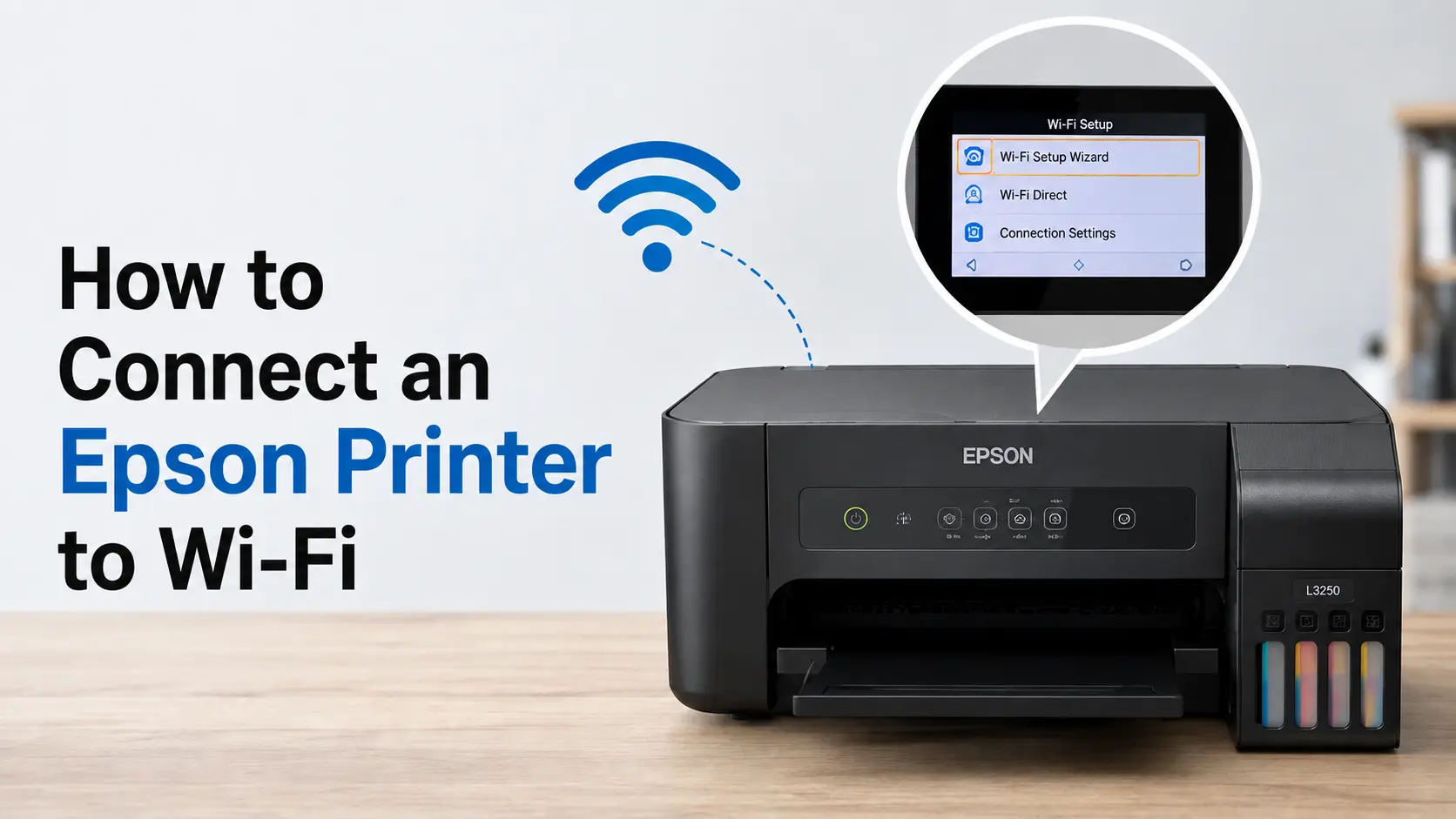
- I-31 — Wireless configuration needed; this typically walks you through connecting via the setup software.
If your printer runs on battery power (Epson's portable WF-100 series, for example), you may also see separate E- and I- codes for battery temperature or charge level, which clear on their own once the printer is back in a normal operating range and reconnected to power.
Common Epson Error Messages (No Code Attached)
"A printer error has occurred." This is Epson's generic fatal-error message, usually followed by an instruction to turn the printer off, then back on. A single occurrence is often just a firmware hiccup. If it repeats every time you power on, unplug the printer for a full minute (not just a power-button off), check the paper path and scanner lid for anything stuck, and reinstall the printer driver before assuming it's hardware failure.
"Printer is Offline." This means your computer can't reach the printer, not that the printer itself is broken. It's almost always a network or queue issue rather than an error on the printer's display. For the full walkthrough, see our Epson Printer Offline guide.
Communication Error. The printer utility shows the device as ready, but the print job never arrives or never completes. This points to the same root causes as an offline status: a dropped Wi-Fi connection, a stuck queue, or a driver that's lost sync with the printer.
"Ink pad is at the end of its service life" / Service Required. According to Epson's own support documentation, the ink pads are the internal components that absorb ink during cleaning cycles and borderless printing. When they're worn out, the printer locks itself to prevent an ink leak. This isn't something a reset tool should paper over. Epson's official channel for this is its Service & Support team.
What to Try Before You Call Anyone
- Write down the exact code or message, word for word. It's the single most useful piece of information if you end up needing support.
- Do a real power cycle. Turn the printer off, unplug it from the wall for a full 60 seconds, then plug it back in. This clears more transient errors than the power button alone.
- Open every cover and check the whole paper path, including spots you can't see from the front, for a torn scrap of paper or a stuck staple.
- Reseat each ink cartridge or tank, pressing down until you feel it click into place.
- Update the printer driver from Epson's support site rather than a third-party download site, since outdated or mismatched drivers are a common cause of communication and offline errors.
- Search your exact model number plus the code on Epson's support site if the steps above don't clear it. The code tables above cover the pattern Epson uses most often, but your specific printer's manual has the definitive list.
For a jam specifically, our Epson Printer Paper Jam guide goes step by step. For a Wi-Fi drop, see Epson Printer Not Connecting to WiFi.