Epson Printer Driver: Download, Setup, and Fixes for Windows, Mac, and Chromebook
Your Epson printer driver is the software that turns "print this page" into instructions your particular printer understands. It also carries the Epson extras: the paper type and quality settings, the ink level readout, and the maintenance tools for nozzle checks and head cleaning. Scanning on an all-in-one runs through a separate scanner driver. That's why an Epson can print perfectly well and still refuse to scan.
When the driver is the problem, it usually shows up as one of these:
Windows lists your printer with Driver is unavailable underneath it.
The printer still prints, but the ink levels, the Maintenance tab, or the photo quality options are gone.
The Epson installer runs and never finds the printer.
Pages print as strings of random characters instead of your document.
Everything was fine until a Windows or macOS upgrade.
The quick answer: Go to epson.com/support, search for your model number, open the Downloads tab, make sure the operating system shown matches your computer, and install the Drivers and Utilities Combo Package. On Windows 11, read "Is Windows Using Epson's Driver or Its Own?" first. Since July 2026, Windows often grabs its own driver the moment it sees a new printer, and that can block Epson's installer.
Which Epson Download Do You Need?
Open any Epson printer's support page and the Downloads tab can list half a dozen items. Here's what each one does.
Drivers and Utilities Combo Package Installer. This is the one most home and small-office users want. It installs the printer driver and, depending on the model, the scanner driver with Epson Scan 2, Epson Event Manager, the FAX Utility on fax models, and Epson Software Updater. On Windows, start here.
Printer Driver. Only the print side. Pick it if you never scan or you're replacing a damaged driver and want to keep the install small.
Scanner Driver and Epson Scan 2 Utility. The scan side of an all-in-one. If printing works but Epson's scan software does nothing, this is usually what's missing.
Epson Software Updater. A small tool that checks for newer versions of the Epson software on your computer. More on it in the update section below.
Epson Universal Print Driver. Listed on many business models, WorkForce Pro in particular. One driver covers several Epson printers, which helps in an office with a mix of models.
Epson Connect Printer Setup Utility and Remote Print Driver. Only needed if you want to print by email or send jobs to your Epson from somewhere else. Neither one replaces the regular driver.
Uninstaller (Mac). Epson's tool for removing its software cleanly from a Mac.
Quick pick by device
Your device
What to install
Windows 11 or 10 PC with an Intel or AMD processor
Drivers and Utilities Combo Package
Windows 11 PC with a Snapdragon (Arm) processor
The Windows 11 on Arm driver, if your model's page lists one. If not, Windows' built-in driver gives you basic printing and scanning.
Mac on macOS 26 Tahoe or macOS 27 Golden Gate
Nothing for everyday printing (AirPrint is built in). Add Epson's driver for Epson's full settings, and Epson Scan 2 if you scan with Epson's software.
Chromebook
Nothing. ChromeOS prints to compatible Epson printers without a driver.
Linux PC
Epson Inkjet Printer Driver (ESC/P-R or ESC/P-R 2) for CUPS
iPhone, iPad, or Android phone
Nothing for printing. Epson Smart Panel is optional, for setup, scanning, and ink checks.
Two Details to Get Right Before You Download
1. Your exact model and your exact system
The model number is printed on the printer, usually on the front near the control panel or on the top cover: ET-2850, WF-2950, XP-5200, and so on. Watch the last digits. An ET-4800 and an ET-4850 are different printers with different downloads.
Then check your computer:
Windows: Go to Settings > System > About. Under Device specifications, the System type line tells you whether you have an x64 processor or an ARM-based processor. If it says ARM, you need an Arm driver, and a regular 64-bit driver won't install.
Mac: Choose Apple menu > About This Mac to see your macOS version. macOS 27 Golden Gate came out on September 14, 2026. If you updated recently, make sure Epson's page is set to macOS 27 and not the version you had before.
Epson's support site usually detects your system on its own, but take two seconds to check the Operating System box before you click Download.
2. Where the file comes from
Get Epson drivers from epson.com/support, or from epson.sn, Epson's setup site, which asks for your model and walks you through a guided install. Both are free.
Epson says plainly that its customer service and support are always free. It also publishes a fraud alert about fake "Epson support" websites and phone lines. These sites are built to look official. A common pattern is a page that asks for your printer model to "download the latest driver," then pushes you to call a number or allow remote access to your computer. If that has already happened to you, Epson points people to local law enforcement, the FBI's Internet Crime Complaint Center (IC3), or the Federal Trade Commission.
Printer Tales is an independent guide and isn't affiliated with Epson. We don't host driver files. Every download step on this page sends you to Epson.
How to Install the Epson Printer Driver on Windows 11 or 10
Do this first on Windows 11. Windows may have added your Epson on its own as soon as the printer appeared on your network. Since July 1, 2026, Windows 11 prefers Microsoft's built-in driver for new printers that support it, and Epson has posted a notice that this feature, called Windows Ready Print, can get in the way of installing the Epson driver. Epson's fix:
Open Settings > Bluetooth & devices > Printers & scanners.
Turn off Default install printers using Windows Ready Print.
If your Epson is already in the list, select it and choose Remove.
If that switch is grayed out, jump to "The installer won't run at all" below.
Then install Epson's driver:
Turn the printer on and connect it to the same Wi-Fi network as your PC. If you use USB, have the cable ready but don't plug it in yet.
Go to epson.com/support, type your model number, and select your printer from the results.
Check the Operating System box on the Downloads tab. It should match your PC, for example Windows 11 or Windows 10 64-bit.
Download the Drivers and Utilities Combo Package Installer. The file ends in .exe.
Open the file from your Downloads folder. Click Yes when Windows asks if the app can make changes.
Accept the license agreement. Leave the list of Epson software checked unless you know you don't need something.
Choose your connection type (Wi-Fi, USB, or Ethernet) when the installer asks. For USB, plug in the cable when the installer tells you to.
Let it search for the printer and finish the setup.
Make sure it worked. In Settings > Bluetooth & devices > Printers & scanners, select your Epson, click Print test page, then open Printing preferences. If you see Epson's Main, More Options, and Maintenance tabs, you're on Epson's driver.
Still on Windows 10? Microsoft ended support for Windows 10 on October 14, 2025, and the consumer Extended Security Updates program only runs through October 13, 2026. Epson still lists Windows 10 drivers, so the steps above work. The printer settings are under Settings > Devices > Printers & scanners, and the Windows Ready Print step doesn't apply.
How to Set Up an Epson Printer on a Mac
Start without downloading anything. Most current Epson printers support AirPrint, which is built into macOS.
Option 1: AirPrint, no driver needed
Connect the printer to the same Wi-Fi network as your Mac.
Open System Settings > Printers & Scanners and click Add Printer, Scanner, or Fax.
Select your Epson. Leave the Use menu on AirPrint (it may say Secure AirPrint) and click Add.
That covers everyday printing. For scanning, Apple's Image Capture app works with many Epson all-in-ones without any Epson software.
Option 2: Epson's driver, for Epson's full settings
Install Epson's driver if you want Epson's own paper profiles, color and quality controls, or its printer utility, or if you prefer scanning with Epson Scan 2.
On epson.com/support, open your model's Downloads tab and set the operating system to your macOS version, for example macOS 27.x.
Download the printer driver, plus Epson Scan 2 if you scan. Open the .dmg file and run the installer inside it.
Go back to Printers & Scanners and add the printer again. This time, open the Use menu and choose the Epson driver for your model instead of AirPrint.
If the printer was already added through AirPrint, remove that entry first so you don't end up with two.
If macOS warns that an Epson app is "Intel-based"
Some Epson utilities were built for Intel Macs and run on Apple silicon Macs through Rosetta, Apple's translation layer. macOS now warns that support for Intel-based apps is ending and that those apps won't work in macOS 28. macOS 27 Golden Gate is the last version with full Rosetta support.
If you see that warning next to an Epson app, check your model's Downloads tab for a newer version. If there isn't one yet, don't panic. AirPrint and Image Capture are part of macOS and don't rely on Rosetta, so basic printing and scanning keep working.
If Epson options vanished after a macOS update
When paper types or Epson's print options disappear after an upgrade, or the printer sits on "waiting for the printer to become available," remove the printer and add it again with the Epson driver selected. If that doesn't do it, reset the printing system using the Mac steps in the clean uninstall section below.
Epson Printers on a Chromebook or Linux PC
Chromebook. There's no Epson driver to install. ChromeOS has native printing, which works with compatible Epson printers without a driver and without a Google account. Put the printer on your Wi-Fi network, press Ctrl + P in Chrome, and pick your Epson from the Destination list. If it doesn't show up, add it from the Printers section of your Chromebook's settings. Older guides that tell you to set up Google Cloud Print are out of date; Google shut that service down at the end of 2020.
Linux. Epson publishes its own Linux drivers: the Epson Inkjet Printer Driver (ESC/P-R) and the newer ESC/P-R 2. Both plug into CUPS, the print system most Linux distributions use. Many distributions already package them, so search your package manager for "escpr" before downloading anything. Otherwise, get them from Epson's Linux download center, which also lists the models each driver supports. Many networked Epsons will also print through CUPS' driverless IPP support with no Epson package at all.
Is Windows Using Epson's Driver or Its Own?
This question sits behind a lot of "my Epson settings disappeared" complaints this year. Microsoft is moving Windows away from manufacturer printer drivers, and it has published this timeline for Windows 11:
Date
What changes
January 15, 2026
New printer drivers are no longer published to Windows Update. Updates to existing drivers are approved case by case.
July 1, 2026
Windows ranks its built-in IPP class driver ahead of manufacturer drivers.
July 1, 2027
Apart from security fixes, third-party printer driver updates are no longer allowed.
What this doesn't mean. Your Epson driver won't suddenly stop working. Microsoft says existing drivers can still be installed, manufacturer installers like Epson's are still allowed, and it has no plans to disable features of the older driver types. Printers you set up before July 2026 keep the driver they already have. The change affects new installs.
How to check which driver your Epson is using
Go to Settings > Bluetooth & devices > Printers & scanners and select your Epson.
Click Printer properties and open the Advanced tab.
Read the Driver line. "EPSON" followed by your model means Epson's driver. Microsoft IPP Class Driver means Windows' built-in one.
Which one should you keep?
Windows' built-in driver is perfectly fine if you mostly print documents. Microsoft pitches it as more dependable across Windows updates, and it works on any PC, including Snapdragon laptops.
What you give up is everything Epson adds: the Main, More Options, and Maintenance tabs, the EPSON Status Monitor ink readout, and the nozzle check and head cleaning tools on your PC. Epson itself notes that its printers have limited functions without the Epson driver. If you print photos, or you regularly change paper type and quality, use Epson's driver. On most models you can still run a nozzle check or head cleaning from the printer's own control panel either way.
To switch to Epson's driver: turn off Default install printers using Windows Ready Print, remove the printer, and run Epson's installer, as in the Windows steps above. The switch only affects printers you add from then on.
When you can't switch: If Windows protected print mode is on, Windows only allows its built-in driver and removes printers that depend on manufacturer drivers. You'll find it under Printer preferences in Printers & scanners. On work and school PCs, it's often set by the IT department and can't be changed from Settings.
How to Fix Epson Printer Driver Errors
Find the heading that matches what you're seeing.
"Driver is unavailable" under your Epson
Windows has an entry for the printer but can't find a working driver to go with it. Usually the driver files got damaged, an update left a mismatch behind, or pieces of an earlier install are still hanging around.
Restart the printer and the PC. It costs you a minute and occasionally clears it.
Remove the printer in Settings > Bluetooth & devices > Printers & scanners.
Clear the old driver package. Press Windows + R, type printui /s /t2, and press Enter. On the Drivers tab, select each Epson entry, click Remove, and choose Remove driver and driver package.
Restart the PC.
Install the current Drivers and Utilities Combo Package from epson.com/support.
If step 3 says the driver is in use, restart the Print Spooler (press Windows + R, type services.msc, right-click Print Spooler, and choose Restart) and try again. If it still won't budge, do the full clean uninstall below.
The Epson installer can't find your printer
Print a network status sheet from the printer's network or Wi-Fi settings menu. Confirm the printer has an IP address and is on the same network name as your PC.
Turn off any VPN on the computer while you install.
Skip the guest network. Guest Wi-Fi often stops devices from seeing each other. Put the printer and the PC on your main network.
Run Epson Printer Connection Checker if your Epson software installed it. Search for it in the Start menu and follow its checks.
Ink levels, the Maintenance tab, or photo settings are missing
The printer is almost certainly running on Windows' built-in driver. Check it and switch using the steps in "Is Windows Using Epson's Driver or Its Own?" above.
Your Epson shows up twice, like "EPSON ET-2850 Series (Copy 1)"
Windows adds a copy when a printer gets installed again while an older entry is still there. Send a test page to each one, keep the one that prints, and remove the other. If Windows keeps switching your default printer, turn off Let Windows manage my default printer in Printers & scanners, then set your Epson as the default.
It prints, but scanning doesn't work
The printer driver doesn't handle scanning. Download Scanner Driver and Epson Scan 2 Utility from your model's Downloads tab, or reinstall the Combo Package, which includes both. If your PC is using Windows' built-in driver, the Windows Scan app can scan from many networked Epson all-in-ones without Epson's software.
The installer won't run at all
Windows 11 in S mode only runs apps from the Microsoft Store, so Epson's .exe installer is blocked. Print with the driver Windows adds on its own, or switch out of S mode. See the FAQ below.
Windows protected print mode blocks manufacturer drivers. See "Is Windows Using Epson's Driver or Its Own?" above.
A Snapdragon or other Arm PC needs an Arm driver. If your model's Downloads tab doesn't list one for Windows 11 on Arm, Epson says Windows' built-in driver will give you basic printing and scanning.
A work or school PC may need an administrator to approve the install.
How to Completely Uninstall and Reinstall an Epson Driver
When the quick fixes don't stick, start clean. Installing a fresh driver on top of a broken one tends to carry the problem over.
On Windows 11 or 10
Turn the printer off, and unplug the USB cable if you use one.
Remove the printer in Settings > Bluetooth & devices > Printers & scanners (Settings > Devices > Printers & scanners on Windows 10).
Uninstall Epson's printer software. Go to Settings > Apps > Installed apps (Apps & features on Windows 10). Find the entry named EPSON [your model] Series Printer Uninstall, click the three dots, and choose Uninstall. If you plan to reinstall everything, remove Epson Scan 2, Epson Event Manager, and Epson ScanSmart the same way.
Clear leftover driver packages with printui /s /t2, as described in the "Driver is unavailable" steps.
Restart the computer with the printer still off and unplugged.
Turn the printer back on and install the latest Drivers and Utilities Combo Package.
On a Mac
Open System Settings > Printers & Scanners, select the Epson, and choose Remove Printer.
Run Epson's Uninstaller. Download it from your model's Downloads tab, open it, check the Epson software you want removed, and click Uninstall.
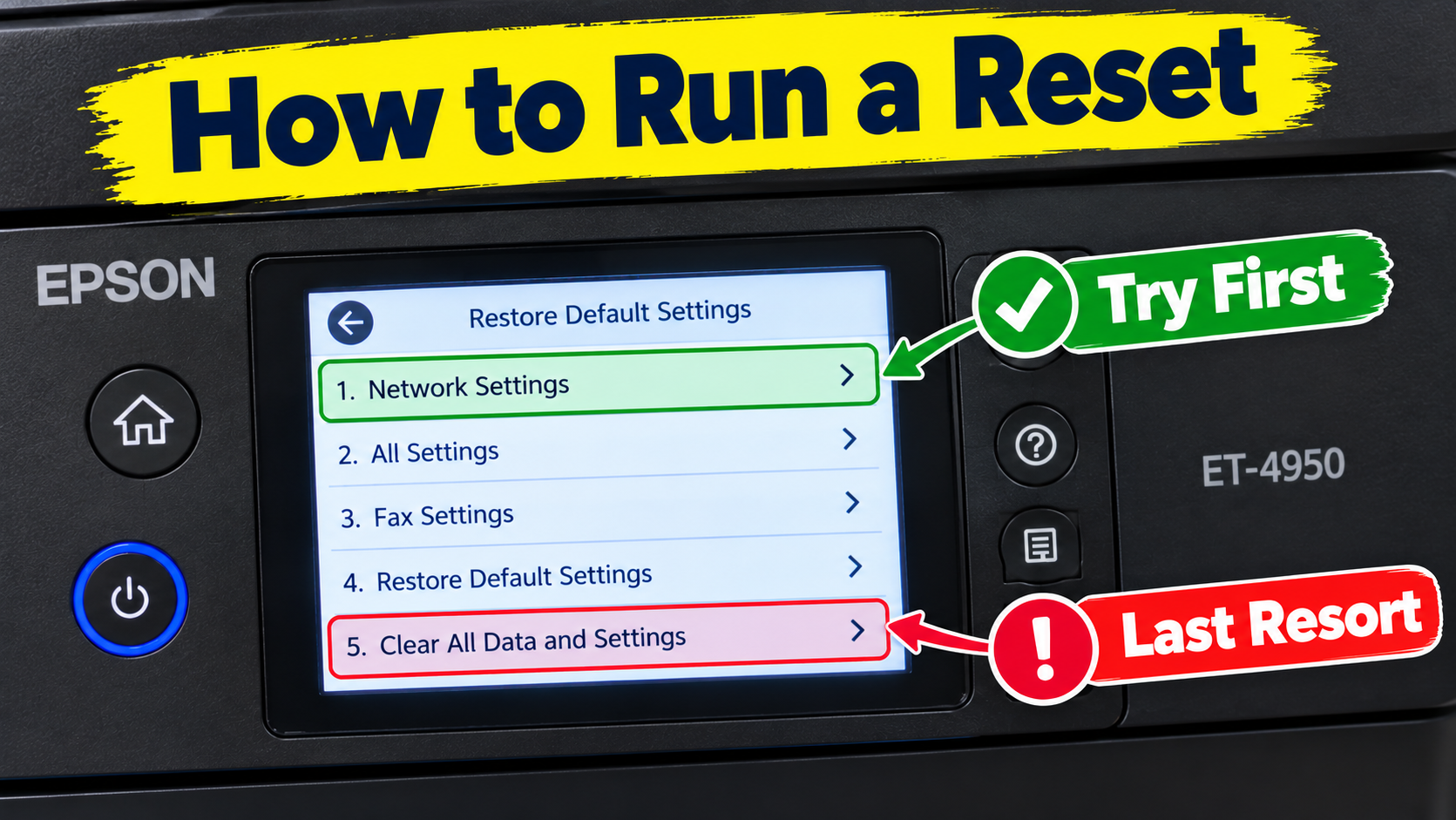
Reset the printing system if the problem is still there. Control-click anywhere in the printers list and choose Reset Printing System. This removes every printer, print job, and preset on the Mac, so you'll need to add your printers back afterward.
Reinstall and add the printer again. Choose the Epson driver in the Use menu if you want Epson's full settings.
How to Update Your Epson Printer Driver
You don't need to chase every release. Update when you move to a new version of Windows or macOS, when something stops working after a system update, or when Epson posts a fix for your model.
Epson Software Updater. Most combo packages install it. On Windows, search for it in the Start menu. On a Mac, look in Applications > Epson Software. It compares the Epson software on your computer with what Epson has posted and, on many models, offers printer firmware updates too.
Your model's support page. Open the Downloads tab with your operating system selected and compare the version and release date with what you installed. If Epson has something newer, download it and run it.
Windows Update. Printer drivers still turn up now and then under Settings > Windows Update > Advanced options > Optional updates. But since January 15, 2026, Microsoft no longer publishes new printer drivers to Windows Update for Windows 11, so Epson's site is the place to find the newest one.
Driver or firmware? The driver lives on your computer. Firmware lives inside the printer and controls how it runs. Epson Software Updater, and on many models the printer's own control panel, can install firmware updates. Once one starts, leave the printer on and connected until it finishes.
Skip third-party "driver updater" programs. They aren't from Epson, and you can't see where their files come from. Epson's own updater and support site do the same job for free.
FAQs
Is the Epson printer driver free?
Yes. Every Epson driver and utility is a free download from epson.com/support, and Epson says its customer service and support are always free. If a website wants you to pay for the driver itself, or claims to be Epson and asks for payment, close it and go to epson.com/support directly.
Which Epson driver do I need for Windows 11?
You need the Drivers and Utilities Combo Package listed under Windows 11 on your model's Downloads tab. If Epson doesn't list a Windows 11 driver for an older model, Epson says the basic driver built into Windows 11 installs on its own once the printer is connected by USB or on the same network.
Can I use my Epson printer without installing a driver?
Often, yes. Macs, iPhones, and iPads print through AirPrint, Chromebooks use ChromeOS native printing, and Windows 11 can print through its built-in IPP driver on printers that support it. You get basic printing. Epson's driver adds its quality and paper controls, ink status, and maintenance tools on your computer.
Will my Epson stop working when Microsoft ends support for printer drivers?
No. Microsoft's plan changes how drivers are delivered and which driver Windows picks for newly added printers. It doesn't switch existing drivers off. Epson's installers still work, existing drivers can still be installed, and Microsoft says it has no plans to remove features of the older driver types.
Does my Epson work with a Snapdragon (Windows on Arm) laptop?
Yes, at least for basic printing and scanning. Epson has been releasing Windows 11 on Arm drivers model by model, so check your model's Downloads tab. Without one, Windows' built-in driver handles the basics, and Microsoft says its built-in printing works regardless of the processor.
My Mac says an Epson app is "Intel-based." Will my printer stop working?
Printing through AirPrint won't be affected. The warning applies to Epson software built for Intel Macs, which runs on Apple silicon through Rosetta. Apple says Rosetta stays fully available through macOS 27 and will be limited in macOS 28. Look for an updated version on Epson's Downloads tab.
Can I install the Epson driver on a PC in S mode?
No. S mode only runs apps from the Microsoft Store, and Epson's installer isn't one of them. You can print with the driver Windows adds on its own, or switch out of S mode for free through the Microsoft Store. Keep in mind that switching out of S mode is one-way.
Do I need a driver to print from my phone?
No. iPhones and iPads print through AirPrint. Android phones can print to compatible printers from the share or print menu using the Mopria Print Service. Epson Smart Panel, Epson's mobile app, is worth adding if you have a recent Epson, since it handles setup, scanning, and ink checks.
Where can I find a driver for an old or discontinued Epson?
Search the model on epson.com/support first, since Epson keeps support pages for many printers it no longer sells. If there's no driver for your current Windows or macOS version, use the built-in option if your printer supports it: Windows' own driver, AirPrint on a Mac, or native printing on a Chromebook.
Printer Tales is an independent troubleshooting resource and is not affiliated with, authorized by, endorsed by, or sponsored by Epson. "Epson" and all related names, logos and model names are trademarks or registered trademarks of Epson or its affiliates, used here only to identify the products these guides cover. Full disclosure.
Cookie Consent
We use cookies to give you the best possible experience on our website. Cookie Policy