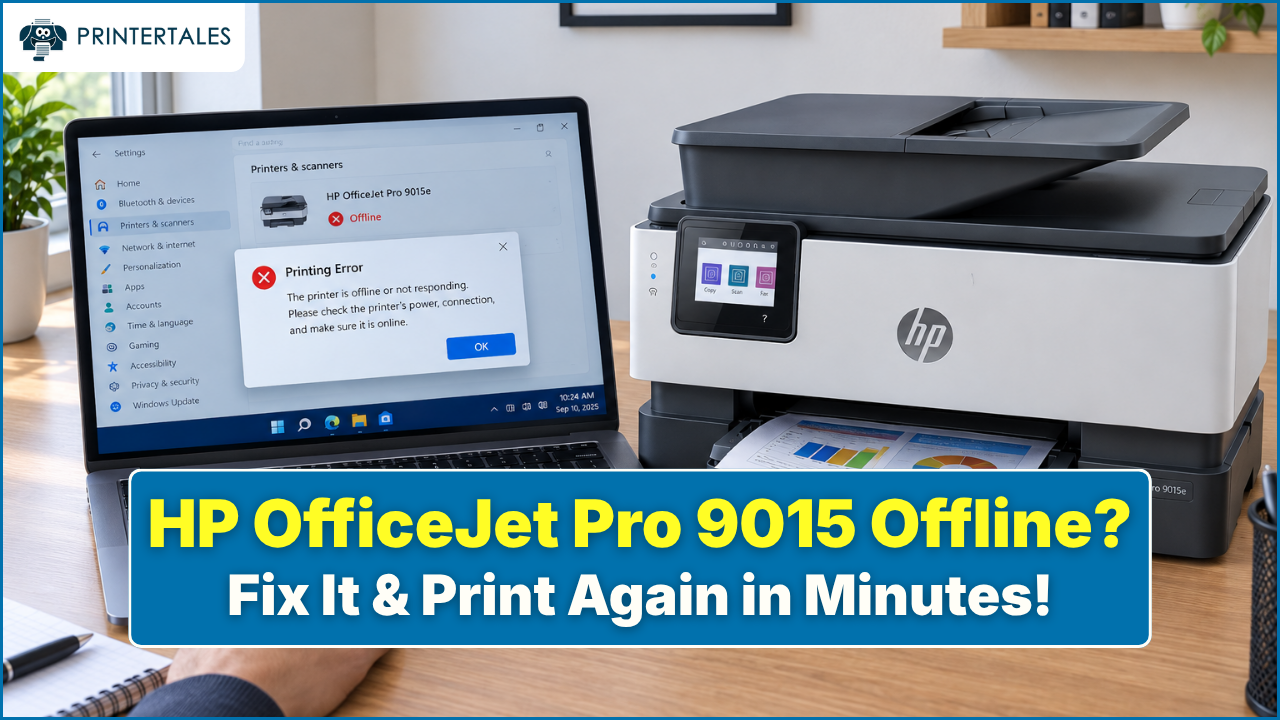
You click Print, nothing comes out, and your computer says your HP printer is offline. Meanwhile the printer is sitting right there with its lights on.
Here's the good news. An offline status rarely means the printer is broken. It means your computer tried to reach the printer and didn't hear back. The usual reasons are a dropped Wi-Fi connection, a Windows setting, or one stuck print job holding everything else up.
This guide starts with a quick test to show you where the problem is. After that, the fixes run from fastest to most involved, so most people are printing again well before the end.
A quick note on HP's tools: Plenty of older guides tell you to download HP Print and Scan Doctor or open HP Smart. HP retired Print and Scan Doctor in May 2025, and the HP app has replaced HP Smart. The steps below use the tools HP supports today.
Why Your HP Printer Shows Offline
"Offline" tells you what happened, not why. The cause almost always sits in one of three places.
On your network
- The printer lost its Wi-Fi connection after a router restart, a power outage, or a Wi-Fi password change.
- Your computer and the printer ended up on different networks, such as a guest network or the printer's own DIRECT setup network.
- The router gave the printer a new IP address, and your computer is still sending jobs to the old one.
- A VPN on your computer is routing traffic away from your local network, so the printer can't be found.
On your computer
- Windows has "Use Printer Offline" or "Pause Printing" switched on.
- A stuck job is blocking the print queue.
- The Print Spooler, the Windows service that handles every print job, has stalled.
- Jobs are going to an old duplicate of the printer that no longer connects.
- Windows is treating your Wi-Fi as a Public network, which applies stricter rules to traffic from devices like printers.
At the printer
- There's an error on the printer itself, like a paper jam, an open door, or a cartridge problem.
- The firmware is out of date. HP ships fixes in firmware updates, and HP includes updating it in its own offline troubleshooting.
Before You Start: Find Out Where the Problem Is
These three checks take about a minute, and they tell you which fixes to focus on.
- Look at the printer's control panel. If you see a paper jam, an open door, an ink message, or a blinking warning light, deal with that first. Sometimes "offline" is just how your computer reports an HP printer in an error state.
- Check the Wireless light. On HP printers that have one, a solid blue light means the printer is connected to the network. If it's blinking or off, the printer isn't connected, so start with Fix 2.
- Try printing from another device. Use your phone with the HP app, or another computer on the same network.
- Nothing can print: the problem is the printer or the network. Start with Fixes 1 and 2.
- Other devices print fine: the printer is okay, and the problem is on your computer. On Windows, skip to Fix 3. On a Mac, go to the Mac section.
How to Fix an HP Printer That's Offline
Try one fix at a time and send a test print after each one. Once it prints, you're done.
Fix 1: Restart Everything in the Right Order
A proper restart clears temporary errors on the printer and forces every device to reconnect. The order matters, so don't skip ahead.
- Turn the printer off with its power button. If it won't turn off, unplug the power cord.
- Shut down your computer.
- Restart your router, and wait until your internet is working again.
- Plug the printer back in and turn it on. HP recommends plugging it directly into a wall outlet instead of a power strip.
- Turn your computer back on and try printing.
Fix 2: Put the Printer and Computer on the Same Network
Your computer can only reach a wireless printer when both are on the same network. They can drift apart without anyone noticing.
- Check your computer's network name. Open the Wi-Fi list and confirm you're on your usual network. Don't connect to a network named DIRECT-xx-HP followed by your printer model. That's a direct link to the printer, not your home or office Wi-Fi.
- Skip guest and public networks. HP notes that a printer connection won't work on networks that make you log in or accept terms first, like the ones in hotels, schools, and coffee shops.
- Move the printer closer. HP suggests keeping it within about 26 feet (8 meters) of your router or range extender. Walls, metal shelving, and other electronics all weaken the signal.
- Watch out for dual-band routers. Many HP printers connect only on the 2.4 GHz band. If your router puts 2.4 GHz and 5 GHz under one network name (often called Smart Connect or band steering), try giving each band its own name so you can keep the printer on 2.4 GHz.
- Turn off your VPN. A VPN sends your computer's traffic through a remote server, and that can cut it off from devices on your own network. Turn it off, print, then turn it back on. If your VPN app has a split tunneling or local network access option, turning that on can let you print with the VPN running.
- Unplug the USB cable if you print over Wi-Fi. HP recommends this to make sure the printer's wireless connection is enabled.
If the Wireless light still won't stay solid, the printer needs to be reconnected to your Wi-Fi. Our guide to fixing an HP printer not connecting to Wi-Fi walks through that for both touchscreen and button-only models.
Fix 3: Turn Off "Use Printer Offline" in Windows
Windows has a checkbox that keeps a printer offline, and it's easy to miss when it's on. Checking it takes less than a minute.
Windows 11 and Windows 10
- Open Control Panel. Under Hardware and Sound, click View devices and printers.
- Right-click your HP printer and choose See what's printing.
- Click the Printer menu at the top of the window.
- If Use Printer Offline has a check mark next to it, click it to clear it. Do the same for Pause Printing.
Close the window and send a test print.
Fix 4: Clear Stuck Jobs and Restart the Print Spooler
One jammed print job can hold up everything behind it and make the printer look offline. Clearing the queue and restarting the service that runs it often brings the printer right back.
- Go to Settings > Bluetooth & devices > Printers & scanners, click your HP printer, and choose Open print queue.
- Click the ... menu and choose Cancel all.
- Type services in the search box on the taskbar, and open Services.
- Scroll down to Print Spooler, right-click it, and choose Restart.
On Windows 10, open the queue from Settings > Devices > Printers & scanners > Open queue, then use Printer > Cancel All Documents.
If a job still won't go away, stop the Print Spooler instead of restarting it. Delete the files inside C:\Windows\System32\spool\PRINTERS, then start the Print Spooler again. If jobs keep piling up, see how to clear an HP printer job stuck in the queue.
Fix 5: Make Sure Windows Is Using the Right Copy of Your Printer
If your printer has been set up more than once, Windows may list two or three versions of it, like "HP DeskJet" and "HP DeskJet (Copy 1)." Your print jobs can end up on a copy that no longer connects to anything.
- Go to Settings > Bluetooth & devices > Printers & scanners.
- Turn off Let Windows manage my default printer. While it's on, Windows keeps making the last printer you used your default.
- Click the copy of your HP printer that shows Idle or ready instead of Offline, and choose Set as default.
Now print from the app you were using, and make sure that copy is the one selected in the print window.
Fix 6: Run Diagnose & Fix in the HP App
The free HP app for Windows and Mac includes Diagnose & Fix, a troubleshooter that looks for common printer problems and walks you through the repairs. HP names it as the replacement for Print and Scan Doctor.
- Get the HP app from the Microsoft Store, the Mac App Store, or 123.hp.com. If you had HP Smart installed, it may have already updated to the HP app.
- Open the HP app and click your printer.
- Click Diagnose & Fix. Depending on your app version, you might find it in the Printers menu, or you may need to scroll down to Diagnostics.
- Click Start and wait for the scan to finish. Keep the app open while it runs.
- Follow any fixes it suggests, then print a test page.
Still have HP Print and Scan Doctor on your computer? HP stopped maintaining it in May 2025 and says it should be removed because of potential security risks. Remove it, and use Diagnose & Fix from now on.
On Windows 11, Microsoft's printer troubleshooter in the Get Help app is also worth running. It checks the Windows side of the connection automatically.
Fix 7: Remove the Printer and Add It Back
When the connection details Windows saved for your printer go stale, starting fresh is often faster than chasing the problem.
- Go to Settings > Bluetooth & devices > Printers & scanners.
- Click your HP printer, choose Remove, and confirm with Yes.
- Make sure the printer is turned on and connected to your network. Then click Add device next to Add a printer or scanner.
- Select your HP printer when it appears and follow the prompts. If it doesn't show up in the list, our HP printer setup issue guide can help.
If you print through the HP app, refresh the printer there too. Click your printer, scroll to the bottom, choose Remove from app, and then add it again.
A note about drivers: Windows is moving new printer setups toward its built-in Microsoft IPP Class Driver. After you add the printer back, you may see that driver listed instead of an HP one. That's normal, and Microsoft stated in February 2026 that printers that work with Windows today will keep working. If you need a feature the built-in driver doesn't offer, install the software for your model from HP's support site. Our HP printer driver guide explains how.
Went offline right after a Windows update? That calls for a slightly different set of steps, covered in our guide to an HP printer not working after a Windows update.
Fixing an HP Printer Offline on a Mac
There are fewer places for things to go wrong on a Mac, so the fix list is shorter. Work through these in order.
- Check the connection first. Confirm your Mac is on the same Wi-Fi network as the printer and that any VPN is off. Fixes 1 and 2 above apply to Macs too.
- Run Diagnose & Fix. Open the HP app for Mac, select your printer, and run Diagnose & Fix, just like in Fix 6.
- Remove the printer and add it back. Open System Settings > Printers & Scanners (System Preferences on older versions of macOS). Click your printer, then click Remove Printer or the minus button. Next, click Add Printer, Scanner, or Fax, choose your HP printer, and click Add.
- Reset the printing system if nothing else works. In Printers & Scanners, Control-click inside the printer list and choose Reset printing system. Be aware that this removes every printer and scanner on your Mac, along with all queued jobs and saved print settings. Restart the HP printer, then add it back.
If Your HP Printer Keeps Going Offline
Getting the printer back online is one thing. Keeping it there is another. If it drops off every few days, one of these longer-term fixes usually breaks the cycle.
Update the printer's firmware
HP releases firmware updates with fixes and improvements, so an older printer that hasn't been updated in a while is worth checking.
- In the HP app: click your printer and open Advanced Settings. On some versions, you'll find it under Printer Settings > View all. Choose Printer Update or Printer Updates, enter the printer PIN if asked, and click Check Now.
- On a touchscreen printer: the menu names vary by model. One common path is Setup > Printer Maintenance > Update Printer > Check Now.
Keep the printer on until the update finishes. HP warns that turning it off in the middle of a firmware update can permanently damage the printer. For more update methods, see how to update HP printer firmware.
Give the printer an IP address that doesn't change
Routers hand out IP addresses automatically, and a printer can come back from a restart with a new one. Your computer keeps looking for the old address and reports the printer as offline. A fixed address stops that.
- Print a Network Configuration Report. In the HP app, click your printer and look for Printer Reports, or More information and reports > Reports. On a touchscreen printer, look in the Wireless or Network Settings menu.
- On the report, find the printer's IP Address, Subnet Mask, Default Gateway, and the URL for the Embedded Web Server.
- Type that URL into a web browser on a computer connected to the same network. This opens the printer's built-in settings page.
- Click the Network or Networking tab, open the Wireless menu, and click IPv4 Configuration.
- Select Manual IP. If you see Suggest a Manual IP Address, click it and check that the numbers match your report. Otherwise, type in the numbers from the report. Click Apply.
Most home routers can also reserve an address for a device, which does the same job from the router's side.
Switch to a Standard TCP/IP port (Windows)
Windows often adds network printers through a WSD port. When a printer keeps showing offline, HP's support team suggests switching to a Standard TCP/IP port, which points Windows directly at the printer's address.
- In Settings > Bluetooth & devices > Printers & scanners, click your printer and open Printer properties.
- On the Ports tab, click Add Port, choose Standard TCP/IP Port, and click New Port.
- Enter the printer's address from your Network Configuration Report, then finish the wizard. HP's own instructions use the IPv6 address listed under 802.11 Wireless, which starts with fe80.
- Make sure the new port is selected, and click OK.
You might see two copies of the printer in Windows afterward. HP advises leaving both in place.
Turn off SNMP status checks (Windows)
Windows uses SNMP to ask network printers whether they're available. When that check doesn't get a proper reply, a working printer can show as offline. In Printer properties, open the Ports tab, select the port your printer uses, and click Configure Port. Clear SNMP Status Enabled and click OK.
Set your home network to Private (Windows)
When Windows treats your Wi-Fi as a Public network, its security rules get stricter and can block traffic from devices like printers. On a home or office network you trust, click the network icon on the right side of the taskbar, open Properties for your connected network, and choose Private. Leave networks at hotels, airports, and coffee shops set to Public.
Signs It's More Than an Offline Glitch
Most offline messages come down to a connection or a setting. It's time to look past this guide if:
- The printer shows an error code or blinking lights that come back after every restart.
- It won't print a Network Configuration Report or any other report from its own control panel.
- It won't turn on, or it shuts itself off.
- It shows offline on every computer and phone, even after you've reconnected it to Wi-Fi from scratch.
For error codes and warning lights, start with our list of HP printer error codes and messages. And if the printer shows as online but pages still don't come out, follow our steps for an HP printer not printing.