Samsung Printer Not Connecting to WiFi? Here's How to Fix It
Step-by-step fixes for Samsung Xpress, ProXpress, and older ML, CLP, and SCX wireless printers, from a two-minute restart to a full wireless setup over USB.
Most of the time, a Samsung printer that won't connect to WiFi is running into one of three things:
It's trying to join a 5 GHz network it can't see.
Your router is using WPA3 security the printer doesn't understand.
The WiFi password it has saved is no longer correct, usually after a new router or a password change.
Start with Fix 1 and work down the list. Most people are printing again by Fix 4 or 5.
One thing worth knowing up front: Samsung sold its printer business to HP, and the deal closed on November 1, 2017. That's why the official Samsung printer drivers, manuals, and setup tools are now on HP's support site, not Samsung's.
Before You Start: What You'll Need
Take a minute to gather these. It saves a lot of back and forth later.
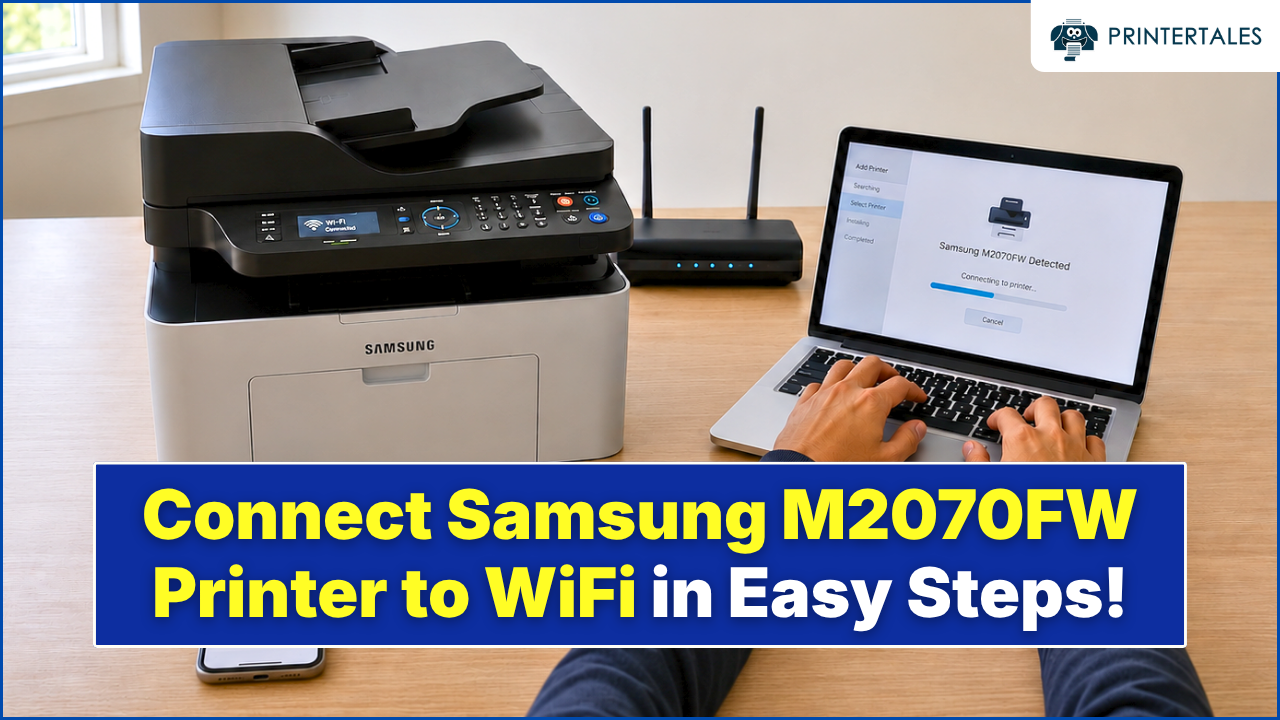
Your printer's model number. It's printed on the front or top of the printer (for example, Xpress M2020W, M2070FW, or C480FW). The "W" in the name means it has wireless built in. If your model doesn't have WiFi, no amount of troubleshooting will add it.
Your WiFi network name (SSID) exactly as it appears, including capital letters and spaces.
Your WiFi password. It's case-sensitive. For WPA and WPA2 networks, Samsung's setup tools expect a password between 8 and 63 characters.
Access to your router's settings. This is usually through an app or a browser page like 192.168.0.1 or 192.168.1.1. You may need it for Fixes 2 and 3.
A USB cable. It's optional, but very handy if your router doesn't have a WPS button.
Why Your Samsung Printer Won't Connect to WiFi
Samsung stopped making printers years ago, but WiFi routers kept changing. A lot of today's connection problems come from an older printer meeting a newer network. These are the most common causes:
Your network is 5 GHz only, or it puts both bands under one name. Samsung wireless printers use 802.11 b/g/n on the 2.4 GHz band. HP's own support documentation for Samsung laser printers says they can't use 5 GHz. Mesh systems and "Smart Connect" routers that put 2.4 GHz and 5 GHz under a single name can confuse the printer.
Your router uses WPA3. Samsung printers support Open, Shared Key, WPA Personal, and WPA2 Personal security. A router set to WPA3 only will turn the printer away even when the name and password are correct.
You got a new router or changed the password. The printer is still trying to log in with the old details. It won't update itself.
The printer can't get an IP address. If the router isn't handing out addresses (its DHCP feature), the printer ends up with a 169.254.x.x address and can't talk to anything.
Weak signal or interference. Thick walls, metal shelving, microwaves, and some Bluetooth devices can all get in the way.
An Ethernet cable is plugged in. Samsung printers can't use wired and wireless at the same time, so a connected network cable blocks WiFi.
The network needs a sign-in page or a username. Hotel, campus, and many office networks make you sign in on a web page, or ask for a username as well as a password (WPA2-Enterprise). Samsung printers only support password-only (Personal) security, so they can't join those networks.
Fix 1: Restart the Printer, Router, and Computer
It sounds too simple, but a proper restart clears stuck network connections and makes the router hand out a fresh IP address. The order matters.
Turn off the printer and unplug its power cord.
Unplug your router, and your modem too if it's a separate box.
Wait a full 60 seconds.
Plug the modem back in first, then the router. Wait until the internet light is solid and your phone can get online.
Plug the printer back in and turn it on. Give it a minute or two to finish warming up.
Restart your computer.
Now try printing. If the printer's wireless or status light is solid and the job goes through, you're done. If not, keep going.
Fix 2: Make Sure the Printer Can See a 2.4 GHz Network
If your network name doesn't show up in the printer's list at all, this is almost always the reason. Samsung wireless printers only work on 2.4 GHz.
If your router shows two network names (for example, "HomeWiFi" and "HomeWiFi-5G"), connect the printer to the one without "5G" in the name.
If your router shows only one name, it's probably combining both bands. This is common on mesh systems and newer routers, where the feature is called Smart Connect or band steering. You have two options:
Turn off band steering or Smart Connect in your router's app or settings page, so the 2.4 GHz and 5 GHz networks get separate names. Connect the printer to the 2.4 GHz one.
Create a separate 2.4 GHz-only network if your router allows it (some routers call this an IoT network). Put the printer there and leave everything else as it is.
Your computer and phone can stay on 5 GHz. As long as everything is on the same router, they can still find the printer.
Fix 3: Check Your Router's Security Settings
If the printer finds your network but fails when you enter the password, the problem is usually the security settings, not the password itself.
Switch WPA3 to WPA2/WPA3 mixed mode. Log in to your router, open the wireless security settings, and look at the 2.4 GHz network. It might say WPA3 only, "WPA3-Personal," or "WPA3-SAE." If so, change it to WPA2/WPA3 mixed (sometimes called transition mode). Your newer devices keep using WPA3, and the printer can connect with WPA2. If your router has no mixed option, use WPA2-Personal with AES.
Double-check the password. Retype it slowly on the printer and watch for:
Capital letters versus lowercase
The number 0 versus the letter O, and 1 versus a lowercase l
Extra spaces at the end
Avoid WEP if you can. Samsung printers support it, but HP's own documentation calls WEP highly insecure and recommends WPA2 instead.
Thinking of using a guest network? It can work, but many routers stop guest devices from seeing each other. If the printer connects but your computer can't find it, that setting is the likely reason.
After saving any router change, restart the router. Then use Fix 4 or Fix 5 to reconnect the printer.
Fix 4: Reconnect Using the Printer's Control Panel (Models with a Screen)
If your Samsung printer has a screen, you can connect it to WiFi without a computer. Menu names vary a little between models, but the path usually looks like this:
Press the Menu button on the control panel.
Go to Network, then Wireless. On some newer models this is labeled Wi-Fi.
Select WLAN Settings, then choose Wizard. The printer searches for nearby networks.
Pick your 2.4 GHz network from the list and press OK.
Enter your WiFi password using the keypad and arrow buttons, then press OK to confirm.
Wait while the printer connects. When it works, the wireless or status light stays on without blinking.
If your network isn't in the list, go back to Fix 2. If your router hides its network name, choose Custom instead of Wizard and type in the network name and security type yourself.
Touchscreen models usually put this under Setup (or the settings icon) on the home screen, then Network, then Wi-Fi.
Fix 5: Connect with the WPS Button (Models Without a Screen)
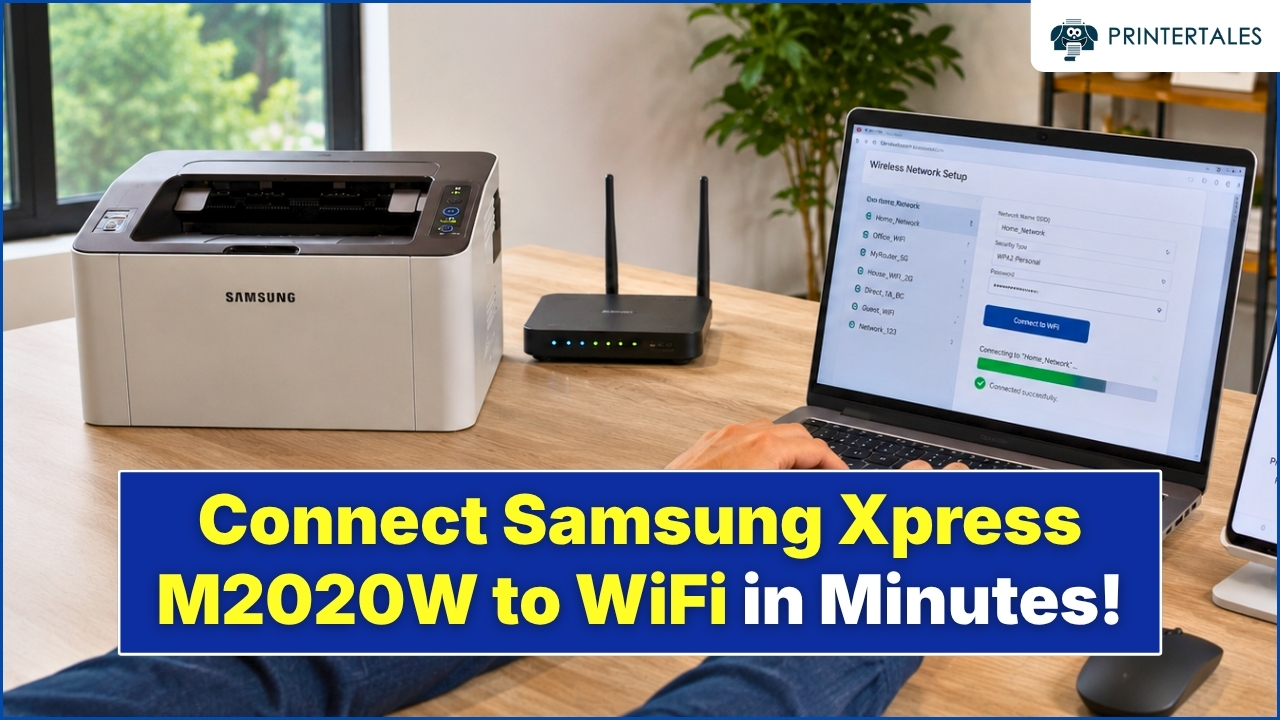
Compact models like the Xpress M2020W don't have a screen, so WPS (Wi-Fi Protected Setup) is the quickest way to connect. You'll need a router with a WPS button or a WPS option in its app.
Make sure the printer is on and not printing anything.
Press and hold the WPS button on the printer for about 2 to 4 seconds, until the status light starts blinking quickly. Then let go.
Within two minutes, press the WPS button on your router, or start WPS from the router's app.
Watch the printer's light. Fast blinking means it's connecting. When the light stays on, you're connected. If it goes off, the attempt failed.
If your router uses a WPS PIN instead: hold the printer's WPS button for more than 4 seconds, until the status light stays on. The printer then prints a page with an 8-digit PIN. Enter that PIN in your router's settings within two minutes.
A couple of things to keep in mind:
WPS won't work if it's turned off in your router. Many newer routers ship with it off or don't have it at all. If that's you, skip to Fix 6.
Once you're connected, it's a good idea to turn WPS back off in the router, especially the PIN method, which is the less secure of the two.
Fix 6: Set Up WiFi Using a USB Cable and Your Computer
This is the most dependable method when a new router has no WPS button. You only need the USB cable during setup. Once the printer is on WiFi, you unplug it.
Option A: Samsung Easy Wireless Setup (Windows)
Download Samsung Easy Wireless Setup from HP's support site. Search for your printer model under Software and Drivers.
Connect the printer to your computer with a USB cable and turn the printer on.
Open Easy Wireless Setup and click Next.
When asked for a setup method, choose Using a USB cable.
Pick your 2.4 GHz network from the list and click Next.
Type your WiFi password in the Network Password field and click Next.
Wait for the connection to finish. This can take a few minutes.
Choose Wireless as the connection type, print a test page, then unplug the USB cable.
Option B: The full driver installer
Download the latest full driver for your model from HP's support site.
Connect the USB cable and run the installer.
For connection type, choose Wireless network connection.
Select Yes, I will set up my printer's wireless network, then Using a USB cable.
Choose your network, enter the password, and follow the prompts.
When the installer tells you to, unplug the USB cable and finish the setup.
Network not in the list? Make sure your router is broadcasting 2.4 GHz (Fix 2). If you know the signal is strong and the network still doesn't appear, click Advanced Settings and type in the network details yourself.
On newer versions of Windows, you can also try Samsung Printer Diagnostics, HP's current tool for Samsung printers. Choose Setting up Wireless printing. It tries WPS first and switches to the USB method on its own if WPS doesn't work.
Fix 7: Set Up WiFi Through SyncThru Web Service
If your Samsung printer has an Ethernet port, you can plug it into the router and set up WiFi from a web browser. You do this through SyncThru Web Service, the printer's built-in settings page.
Connect the printer to your router with an Ethernet cable.
Find the printer's IP address by printing a network configuration report (see Fix 8).
Type that IP address into a browser on a computer connected to the same network.
Click Login. The factory default login is ID admin and password sec00000. If someone changed it, you'll need the new one.
Go to Settings > Network Settings > Wireless (or Wi-Fi) > Wizard.
Pick your network, enter the password, and apply the settings.
Unplug the Ethernet cable once it's done. Samsung printers can't use wired and wireless at the same time, so WiFi won't take over while the cable is plugged in.
If you're still using the default password, it's worth changing it while you're logged in.
Fix 8: Print a Network Configuration Report and Check the IP Address
This one-page report shows what the printer itself sees. It lists the network name, IP address, and MAC address.
How to print it:
Models with a screen: press Menu, then go to Network > Network Conf. (Network Configuration).
Touchscreen models: go to Setup > Network > Network Configuration.
Models without a screen: while the printer is idle, press and hold the Cancel or Stop/Clear button for about 5 seconds.
What to look for:
The IP address starts with 169.254. The printer isn't really on your network, because it couldn't get an address from the router. Restart the router, then reconnect the printer using Fix 4, 5, or 6.
The IP looks normal (like 192.168.1.45) but the network name is wrong. The printer joined a neighbor's open network or an old one. Reconnect it to yours.
The network and IP are correct, but it keeps dropping. Your router may be giving the printer a new IP address now and then while your computer keeps looking at the old one. Give the printer an address that never changes. The easiest way is to reserve an address for it in your router (often called a DHCP reservation), using the MAC address from this report. HP also suggests setting a static IP address on the printer.
Fix 9: Improve the WiFi Signal Where the Printer Sits
If your printer connects but keeps dropping off, the signal may be the problem. Samsung's own manuals point to the same few causes:
Distance and walls. Concrete, brick, and walls with metal inside weaken 2.4 GHz signals a lot. Try moving the printer closer to the router, even just for a test, to see if the drops stop.
Metal objects. Filing cabinets, metal shelves, and appliances between the printer and router can block the signal.
Interference. Microwaves and some Bluetooth devices share the 2.4 GHz band. Keep the printer and router away from them.
If you can't move the printer, a mesh node or range extender near it can help. Just make sure it puts out a 2.4 GHz signal.
Printer Is Connected to WiFi but Your Computer Says It's Offline
If the network report shows a good IP address on your network but Windows still says Offline, the printer is fine. The problem is how your computer is trying to reach it. HP recommends a few Windows fixes for Samsung printers:
Check the port. Open Control Panel > Devices and Printers, right-click the printer, choose Printer Properties, and open the Ports tab. The IP address on the checked port should match the one on your network configuration report. If it doesn't, update it or reinstall the printer.
Turn off SNMP status. On the same Ports tab, click Configure Port and uncheck SNMP Status Enabled. This stops Windows from marking the printer offline when it doesn't answer a status check fast enough.
Printer doesn't wake from sleep? On the Ports tab, uncheck Enable bidirectional support, click Apply, and try printing again.
Check that you're on the same network. Make sure your computer isn't on a guest network or a VPN that keeps it apart from the printer.
If you used Easy Wireless Setup, the driver installer, or Samsung Printer Diagnostics, you may have seen one of these messages. Here's what each one means:
Message
What it means
What to do
Network Not Found / SSID Not Found
The printer can't find your network name
Make sure the router is on and broadcasting 2.4 GHz (Fix 2). Check the spelling of the network name.
Invalid Security / Invalid Network Security
The password or security type doesn't match
Retype the password and check for WPA3 (Fix 3).
Connected to Wired Network
An Ethernet cable is plugged into the printer
Unplug the cable and restart the printer.
IP Address Not Assigned
The router didn't give the printer an address
Restart the printer and router. Make sure DHCP is turned on in the router.
Computer Connection Error / PC Connection Error
The printer joined WiFi, but your computer can't reach it
Put the computer on the same network as the printer. Check for guest networks or VPNs.
General Connection Error
The connection timed out or failed for an unknown reason
Check that other devices work on the same network, restart everything, and try again.
FAQs
Can a Samsung printer connect to 5 GHz WiFi?
No. Samsung wireless printers only use the 2.4 GHz band. If your router puts both bands under one name, turn off band steering or create a separate 2.4 GHz network, then connect the printer to that. Your other devices can stay on 5 GHz.
Why did my Samsung printer stop working after I got a new router?
The printer is still trying to connect with your old network name and password, and it won't pick up the new details on its own. Reconnect it using the control panel, the WPS button, or a USB cable. Also check that the new router isn't set to WPA3 only.
How do I connect my Samsung printer to WiFi if my router has no WPS button?
Use a USB cable. Connect the printer to your computer, run Samsung Easy Wireless Setup or the full driver installer, and choose "Using a USB cable" as the setup method. Enter your network details, then unplug the cable when setup finishes. If your printer has a screen, you can also use the wireless wizard on the control panel.
How do I know if my Samsung printer is connected to WiFi?
Print a network configuration report. If it shows your network name and an IP address that doesn't start with 169.254, the printer is connected. On models without a screen, a status or wireless light that stays on without blinking is also a good sign.
Why does my Samsung printer keep disconnecting from WiFi?
The most common reasons are a weak signal, interference from things like microwaves, or the router giving the printer a new IP address. Move the printer closer to the router. Then reserve an address for it in the router using its MAC address, so its IP never changes.
What is the default SyncThru Web Service password?
The factory default login is ID "admin" and password "sec00000." If that doesn't work, someone has changed it. Once you're logged in, change it to something of your own.
Can I print from my phone without WiFi?
Yes, if your printer supports Wi-Fi Direct. It lets up to four mobile devices connect straight to the printer without a router. It's a handy workaround while you sort out your home network.
Does Samsung still support its printers?
No. Samsung sold its printer business to HP in 2017, so HP now handles support, drivers, and manuals for Samsung printers. You can find downloads by searching your model on HP's support website.
Printer Tales is an independent troubleshooting resource and is not affiliated with, authorized by, endorsed by, or sponsored by Samsung. "Samsung" and all related names, logos and model names are trademarks or registered trademarks of Samsung or its affiliates, used here only to identify the products these guides cover. Full disclosure.
Cookie Consent
We use cookies to give you the best possible experience on our website. Cookie Policy