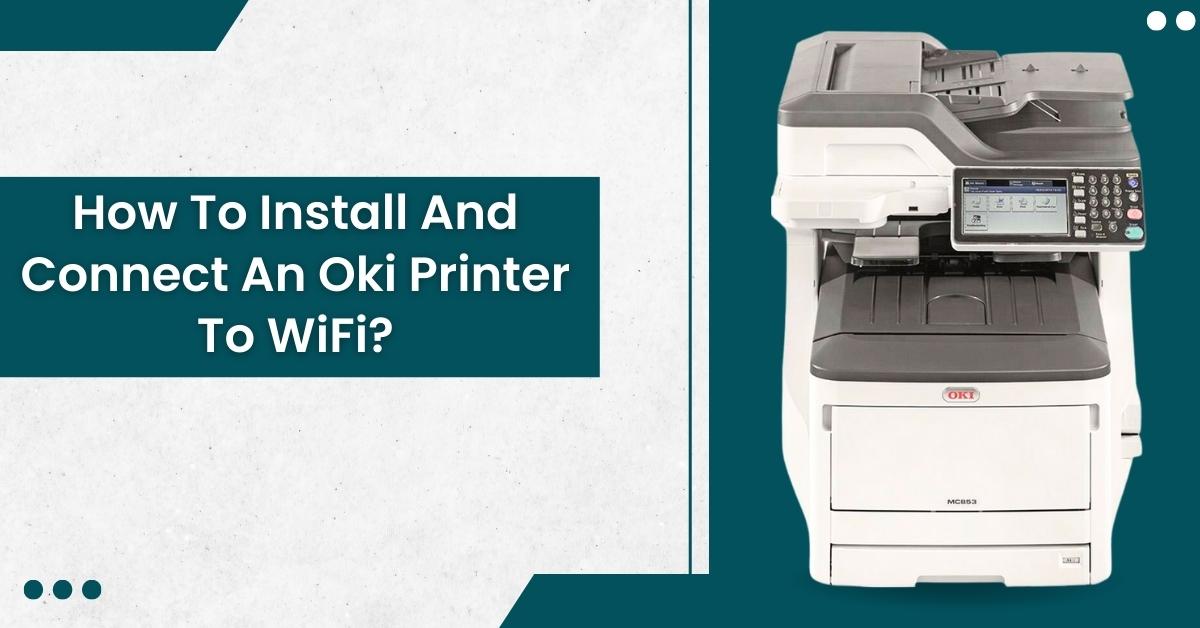
When an OKI printer drops off Wi-Fi, it rarely announces it clearly. Print jobs sit in the queue, your computer lists the printer as offline, or the setup screen keeps ending with "Connection failed." On models with a display, the small antenna icon in the top corner of the screen is gone, which is the quickest sign that the printer has lost the network.
The cause is usually one of a handful of things: the wireless feature was never switched on, the Wi-Fi password or router changed, the signal is too weak where the printer sits, or the printer picked up a new IP address and your computer is still looking for the old one. The steps below start with the quick fixes and move on to the settings that solve the stubborn cases. Menu names vary a little between OKI models, so use them as a guide and match them to what you see on your printer's panel.
Basic Steps (For Beginners)
Solution 1: Restart Your Router, Printer, and Computer in the Right Order
Order matters here. If the printer comes back online before the router is ready, it can fail to get an address and stay disconnected.
- Turn off the OKI printer with its power switch.
- Unplug your router (and modem, if it's a separate box) for about 30 seconds, then plug it back in.
- Wait until the router's lights show it's fully back online and other devices can browse the internet again.
- Turn the printer back on and give it a minute or two to finish warming up.
- Restart your computer, then send a test page.
If the antenna icon returns on the printer's display, the connection is back. If it doesn't, move on to Solution 2.
Solution 2: Check the Wi-Fi Name and Password the Printer Is Using
A surprising number of "sudden" disconnects happen right after something changed on the network side: a new router from your internet provider, a reset router, or a Wi-Fi password update. The printer keeps trying the old details and never tells you why it's failing.
- Confirm the network name (SSID) and password you expect the printer to use. They're usually printed on a label on the router, or listed in your provider's app.
- Remember that the password is case sensitive, and the printer needs the exact SSID, including any spaces or hyphens.
- If anything has changed recently, skip straight to Solution 4 and connect the printer again with the new details.
Solution 3: Move the Printer Closer and Clear the Signal Path
OKI recommends keeping the printer within about 30 meters (roughly 100 feet) of the wireless access point, ideally with a clear line of sight. In real offices and homes, walls cut that distance down fast.
- Keep the printer away from microwave ovens and digital cordless phones, which OKI specifically lists as sources of interference.
- Metal shelving, aluminum window frames, and concrete or brick walls between the printer and the router make a stable connection much harder.
- If moving the printer isn't practical, a mesh node or access point closer to it usually fixes a weak signal for good.
Solution 4: Reconnect Using WPS or the Network List
If your router has a WPS button, this is the fastest way to reconnect an OKI printer without typing a password on a small screen.
- On the printer, open the wireless settings. Depending on the model this is Wireless(Infrastructure) Setting, or it sits under Setting or Admin Setup > Network Setup.
- Enter the administrator password when asked (see the FAQ below if you don't know it).
- Make sure Wireless(Infrastructure) is set to Enable.
- Choose Automatic Setup (WPS), then WPS-PBC (push button), and confirm.
- Within about two minutes, press and hold the WPS button on your router until the printer shows that the connection was successful.
If the router doesn't support WPS, choose Wireless Network Selection instead. The printer scans for nearby networks, you pick yours, and you type the password (OKI calls it the encryption key or pre-shared key). Once you see "Connection successful," close the screen and check for the antenna icon.
Advanced Steps
Solution 5: Print the Network Information Report and Read It
Before changing more settings, let the printer tell you what's wrong. From the operator panel, go to Print Information > Network (on some models it's under Functions > Print Information). The wireless section of the report shows:
- Status: if it says anything other than "Connected," the printer isn't joined to the access point at all.
- SSID: check that it's your network name, spelled exactly right. If it's blank, wireless was never fully set up.
- Security: this has to match the security type your router uses.
- Band: whether the printer is on 2.4 GHz or 5 GHz.
- RSSI (signal strength): a low number points to a distance or interference problem rather than a settings problem.
This one page usually narrows the problem to a password, a security mismatch, or weak signal within a minute.
Solution 6: Make Sure the Wireless Module Is Actually Enabled
On several OKI models, there's no wireless menu at all until the feature is switched on. The OKI C332dnw, for example, ships with its wireless LAN module built in but disabled by default. On other models (such as the C824 and MC363dn), Wi-Fi requires an optional OKI wireless LAN module to be installed first.
If you can't find any wireless menu:
- Check that the wireless module is installed and its connector is seated. On the C332 it sits behind a small cover on the right side of the printer.
- Enable it from the boot menu. On the C332, hold OK while powering on until BOOT MENU appears, enter the admin password, go to Wireless Module, and select Enable. The printer restarts on its own.
- On some newer models, the setting is Admin Setup > Network Setup > General Setup > Extended Network, which needs to be set to Wireless.
Solution 7: Turn Off AP Mode and Recheck Security Settings
OKI printers have two wireless modes: Infrastructure, which connects to your router, and AP Mode, which lets a phone or laptop connect straight to the printer. OKI's manuals are clear that both can't be enabled at the same time. If AP Mode was switched on at some point, set Wireless(AP Mode) to Disable and Wireless(Infrastructure) to Enable.
Next, check the router's security type against the printer:
- OKI's documentation lists WPA/WPA2-PSK (and WEP on some models) for home and small office networks, plus WPA2-EAP for enterprise networks. We haven't seen WPA3 listed for these printers, so if your router is set to WPA3 only, switch it to WPA2/WPA3 mixed (transition) mode.
- WPA-EAP and WPA2-EAP can't be set from the operator panel. They have to be configured through the printer's web page.
- If you type the key manually and it contains the same character twice in a row, press OK between the two entries. On some OKI panels, pressing the same number key twice cycles to a letter instead, so "1233" can end up saved as "12d."
Solution 8: Watch for Band Steering, Guest Networks, and Router Filters
Modern routers do a few things that confuse printers:
- Combined 2.4 GHz and 5 GHz networks (band steering): many OKI wireless modules support both bands, but a printer can still struggle when the router keeps moving it between them. If your router lets you split the bands into two network names, connect the printer to one of them. OKI suggests trying the 5 GHz network when the 2.4 GHz band is crowded.
- Guest networks: these usually block devices from seeing each other, so your computer can't reach a printer connected there. Put the printer on the main network.
- MAC address filtering or access control: if your router only allows approved devices, add the printer's MAC address (it's on the Network Information report).
Solution 9: Fix IP Address and Printer Port Problems
Sometimes the printer is on Wi-Fi just fine, but your computer is looking for it at the wrong address. By default, OKI printers usually get their IP address automatically, and that address can change after a router restart.
- Compare the IP address on the Network Information report with the one your computer uses for the printer.
- To stop it changing, set up a DHCP reservation for the printer in your router, or set IP Address Set to Manual on the printer and enter a free address, subnet mask, and gateway from your network.
- On Windows, if the printer uses a WSD port and keeps going offline, OKI recommends adding a Standard TCP/IP port with the printer's IP address instead. You can do this from the printer's properties under the Ports tab.
- On a Mac, removing the printer in System Settings > Printers & Scanners and adding it again often clears a stale connection.
- If the printer is plugged into Ethernet and on Wi-Fi at the same time, OKI warns that connecting both to the same subnet can make communication unstable. Unplug the cable if you only need wireless (some models, such as the MC853 and MC873, can't use both at once anyway).
Solution 10: Reset the Network Settings and Start Fresh
When settings have been changed many times, a clean slate is often faster than hunting for the one wrong value. This resets network settings only, not your print settings.
- Go to Admin Setup and enter the administrator password.
- Open Network Setup (or Network Menu > Network Setup, depending on the model).
- Choose Network Factory Defaults (or Factory Defaults) and confirm with Execute or Yes.
- Once the printer restarts, set up Wi-Fi again using Solution 4.
After the reset, it's also worth checking OKI's support site for any firmware update for your model, since some wireless features and fixes arrive through firmware. If the printer still won't connect after a clean reset and a strong signal, the wireless module itself may be faulty, and a USB or wired Ethernet connection will keep you printing in the meantime.
For more help, see our guides on OKI printer offline, OKI printer setup issues, and OKI printer drivers.