Samsung Printer Setup Issue: How to Finish a Stuck Setup
Wi-Fi light blinking and going nowhere? Installer can't find the printer? Computer won't add it? This guide takes you through each stage of a Samsung printer setup and shows you how to fix the one where you're stuck.
Setting up a Samsung printer today works a little differently than it did when the printer was new. Samsung sold its printer business to HP in 2017, so the drivers, the wireless setup tool, and the manuals are all on HP's website now. The CD in the box is years out of date, and plenty of computers don't have a disc drive anyway.
Most Samsung printers were also built before WPA3 security and before Windows 11 came along, and some of today's router and computer defaults quietly get in the way. The good news is that Xpress, ProXpress, and older ML, SCX, CLP, and CLX models tend to fail in the same few places. Find yours in the table below and go straight to the fix.
Where Did Your Samsung Printer Setup Stop?
What you're seeing
Most likely cause
Go to
You can't find a driver, or Samsung's site sends you to HP
Samsung printer support moved to HP
Step 2
The printer is plugged in by USB, but the computer doesn't see it
Cable, port, or a missing driver
Step 3
The WPS light blinks for a while, then gives up
WPS is off on the router, or the two-minute window ran out
Step 4
Your Wi-Fi network isn't in the printer's list
A 5 GHz network or a hidden network name
Step 5
The setup software shows a "Connection Failure" message
Password, security type, or an Ethernet cable
Step 5
The printer is on Wi-Fi, but your computer can't find it
Different networks, a firewall, or a changed IP address
Step 6
Your Mac asks for software or won't add the printer
No AirPrint on that model, or an old 32-bit driver
Step 7
Your phone can't see the printer
Print service turned off, or the model lacks Mopria or AirPrint
Step 8
Why Samsung Printer Setup Fails
Nearly every failed Samsung setup comes back to one of three places.
At the printer
An Ethernet cable is still plugged in. Samsung printers can't use wired and wireless networking at the same time, so a cable left in the back stops Wi-Fi from connecting.
The printer still has your old router's settings. If you replaced the router or changed its network name or password, the printer won't pick that up by itself. It has to be set up on the network again.
The model has no Wi-Fi. Only some Samsung printers have it. On Xpress models, a W at the end of the model code (M2020W, M2070FW, M2835DW) usually means Wi-Fi is built in.
On the network
The printer can't see 5 GHz. HP's Samsung support documents say these printers don't have 5 GHz capability. A router that only offers 5 GHz, or blends both bands under one name, can leave the printer with nothing to join.
The router is set to WPA3 only. Samsung's setup software offers WEP, WPA Personal, and WPA2 Personal. Nothing newer.
The router is locked to 802.11n only. Samsung's manual warns that a router set this way may not connect to the printer.
The network wants you to sign in on a web page. Hotel, dorm, and similar Wi-Fi works that way, and the printer can't get past the login screen.
WPS is off on the router. The push-button method needs it turned on at both ends.
On the computer
The software is old. It came from the original CD or a third-party driver site instead of HP.
The computer and printer are on different networks. A guest network, a range extender with its own name, or a VPN can keep them apart.
Security software is blocking the search. Samsung's own troubleshooting names firewall software as a reason the installer can't find a printer that's sitting on the same network.
The printer's IP address changed. Windows keeps sending jobs to the old address.
The Mac or phone expects AirPrint or Mopria, and that particular Samsung model doesn't support it.
How to Fix Samsung Printer Setup Problems
Work through these steps in order. Steps 1 and 2 take a few minutes, and they prevent a lot of the problems further down.
Step 1: Get the Printer Ready and Note Its Exact Model
Unpack it fully. Take off all the tape and packing material, including anything around the toner area. Put in the toner cartridge and load paper.
Turn it on and let it warm up. Wait until the printer goes quiet and the lights settle before you connect anything.
Find the full model code. It's on the printer's rating label and looks something like SL-M2020W or SL-C480FW. The front of the printer may just say "Xpress M2020W," but you'll need the full code to find the right downloads on HP's site.
Going wireless? Unplug any Ethernet cable now.
Print a network configuration report. It lists the printer's IP address, MAC address, and network status, and you'll use it again in Steps 5 and 6.
Models with a display: press Menu, then go to Network > Network Conf.
Models with a touch screen: go to Setup > Network > Next > Network Configuration.
Xpress M2020W and other M2020 models: hold the WPS button for more than 10 seconds.
Other models without a display: hold the Cancel (Stop/Clear) button for about 4 to 5 seconds.
Button layouts vary a bit from model to model. If none of these work on yours, the user guide on HP's page for your printer shows the right one.
Step 2: Download Samsung Printer Software From HP, Not the CD
HP finished buying Samsung's printer business on November 1, 2017. Since then, Samsung printer drivers, utilities, and manuals have been published on HP's support site, and that's the only place you should download them from.
Go to support.hp.com and open Software and Drivers.
Enter the full model code from Step 1 (for example, SL-M2020W) and choose your printer.
Check that HP detected the right operating system. Change it if it didn't.
Expand the list and download what you need.
What you'll see depends on the model. For a wireless Xpress printer on Windows, the list usually looks something like this:
Download
What it's for
[Series] Print Driver
The full installer. It sets up the driver and walks you through a USB, network, or wireless connection. Start here.
Print Driver (No Installer)
Driver files without the setup wizard. Use it if you're adding the printer by hand in Windows.
Samsung Universal Print Driver
One driver that covers many Samsung models. Worth trying if your model's own driver won't install.
Samsung Easy Wireless Setup
Gets a wireless model onto your Wi-Fi through a temporary USB connection.
Samsung Printer Diagnostics
Checks for installation and driver problems and can set up wireless printing.
Samsung Easy Printer Manager
Printer settings after setup, including Wi-Fi Direct.
Why not just use the CD? The disc software is older than Windows 11 and current macOS versions, and HP has updated Samsung drivers since then. In September 2024, HP put out a security bulletin (CVE-2024-5760) rating a flaw in an older build of the Samsung Universal Print Driver for Windows as high severity, and posted a fixed version on its download pages. Third-party driver sites can't promise you're getting the patched build, so skip them too.
Need more help installing or updating the driver? Our Samsung printer driver guide covers it step by step.
Step 3: Set Up Your Samsung Printer With a USB Cable
USB is the fastest way to get one computer printing. It's also a good test: if the printer works over a cable, the hardware is fine, and whatever's left is a network problem.
Run the full Print Driver installer from Step 2, accept the agreements, and choose the USB option when it asks how the printer is connected.
Plug in the cable when the installer tells you to. Use a standard USB printer cable (the square end goes into the printer) and connect it straight to the computer, not to a hub, dock, or monitor.
Finish the install and print a test page.
Windows 10 and 11 will often add a USB printer on their own the moment you plug it in. That's fine for basic printing. If you want scanning on a multifunction model, or Samsung's print settings, run HP's installer anyway.
Computer still not seeing it? Try a different USB port and a different cable, then restart the printer and the computer.
Step 4: Connect Your Samsung Printer to Wi-Fi
Getting the printer onto Wi-Fi and adding it to your computer are two separate jobs. This step does the first one. Pick the method that suits your printer and router.
Method A: WPS push button (no computer needed)
Use this if your router has a WPS button and WPS is turned on in the router's settings.
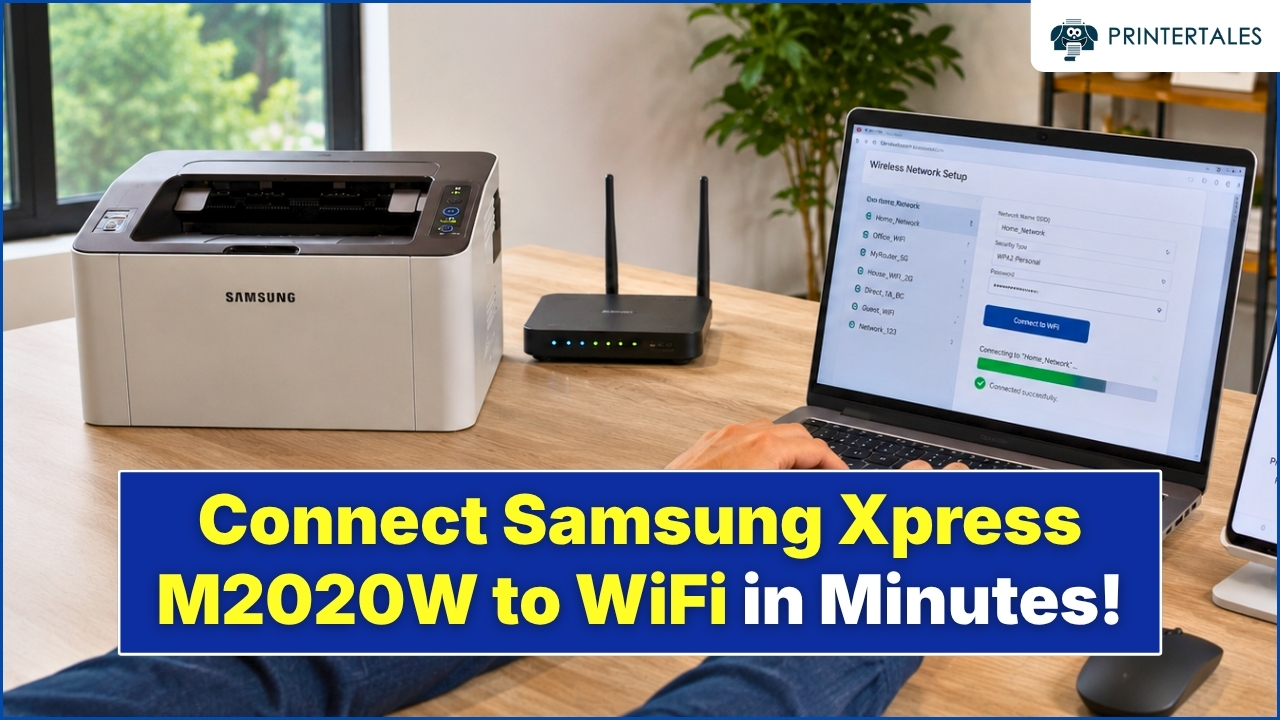
Models without a display (like the Xpress M2020W): Hold the printer's WPS button for about 2 to 4 seconds, until the status light blinks quickly, then let go. The light then blinks slowly while it waits for your router. Press the router's WPS button within two minutes. When the printer connects, its WPS light stays on.
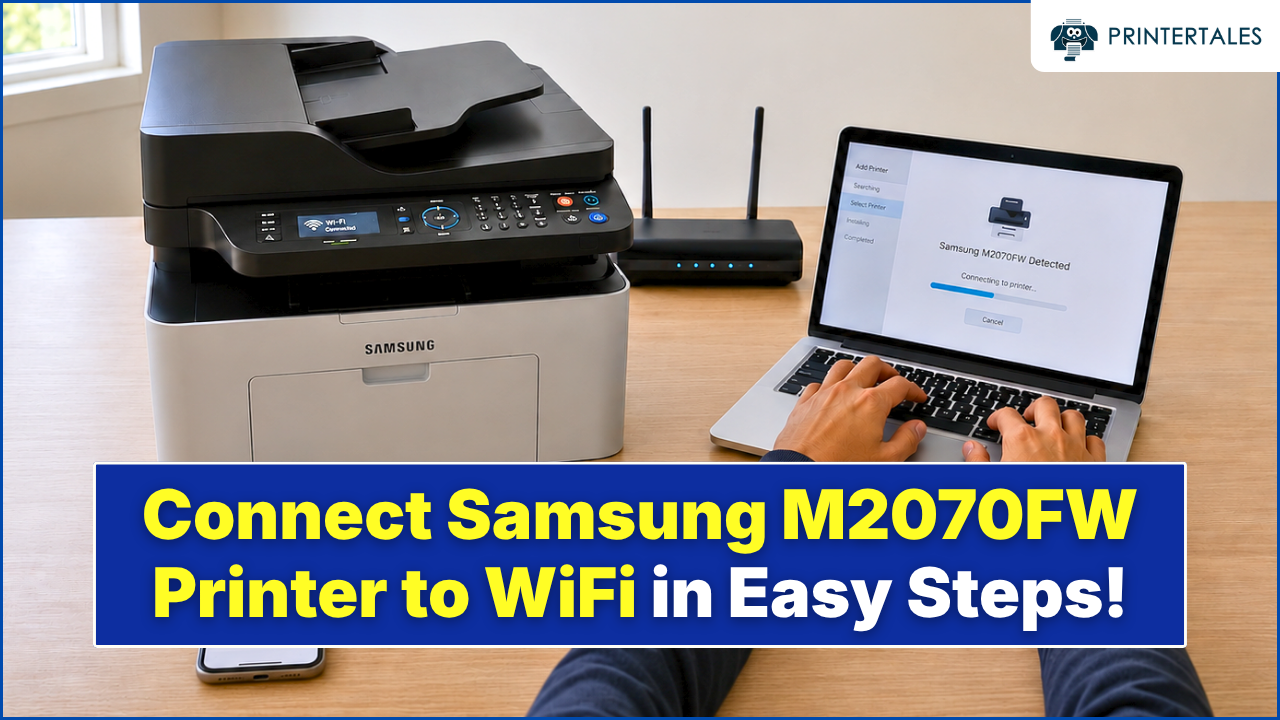
Models with a display (like the Xpress M2070W and M2070FW): Hold the WPS button for more than 2 seconds, then press the router's WPS button within two minutes. The screen shows Connecting, then Connected, and then your network name.
If the light keeps blinking slowly and then goes out, the printer never heard back from the router. Check that WPS is on in the router's settings and try again.
Method B: The printer's own screen (display models)
No WPS? If your printer has a screen, you can choose the network and enter the password right on the printer.
Press Menu and go to Network > Wireless > WLAN Settings.
Choose Wizard. The printer scans for networks and lists the ones it finds.
Pick yours and enter the password with the arrow buttons. Capital letters count.
If your network name is hidden, choose Custom instead of Wizard and type the name in yourself.
Method C: From a Windows PC with a USB cable (works without WPS or a screen)
This is the fallback that works for almost any wireless Samsung model. You only need the cable while you set it up.
Connect the printer to the PC with a USB cable and turn it on.
Run Samsung Easy Wireless Setup from HP's download page and click Next through the opening screens.
When it asks for a setup method, choose Using a USB cable.
Pick your network from the list and enter the password. If your network isn't listed, or it's hidden, open Advanced Setting and type in the network name, security type, and password yourself.
When the software says you're connected, unplug the USB cable and print a test page.
The full Print Driver installer can do the same thing. Choose Wireless network connection, then Yes, I will set up my printer's wireless network, then Using a USB cable.
On a Mac? HP lists the Mac version of Easy Wireless Setup as compatible with macOS 10.5 through 10.14 only. On a newer Mac, use WPS, the printer's screen, or borrow a Windows PC for this method.
Method D: Samsung Printer Diagnostics
Samsung Printer Diagnostics, also on HP's download page for many models, has a Setting up Wireless printing option. It tries WPS first and only asks for a USB cable if that doesn't work. Your computer may lose its internet connection for a moment while it runs. That's expected.
Prefer a cable? If your Samsung has an Ethernet port, plugging it into the router skips Wi-Fi altogether and is the steadiest connection you can get. Just remember the printer won't use Wi-Fi while that cable is connected.
Step 5: Fix a Samsung Printer That Won't Join Your Wi-Fi
If none of the methods in Step 4 worked, the router is usually the thing to look at. Go through these in order.
Use 2.4 GHz. Samsung printers can't connect on 5 GHz. If your router puts both bands under one network name, turn on the 2.4 GHz band or give it its own name while you set up the printer.
Check the security type. A router set to WPA3 only will turn the printer away. Switch it to WPA2/WPA3 mixed mode (some routers call it transition mode) or WPA2-Personal with AES. Stay away from WEP. HP calls it highly insecure.
Don't lock the router to 802.11n. Use a mixed b/g/n mode instead.
Skip networks with a sign-in page. If you have to log in through a web page to get online, the printer can't connect.
Retype the password slowly. It's case sensitive. If the Next button in Samsung's software stays grayed out, the password isn't a valid length for the security type you picked.
Move the printer closer for setup. Samsung's manual calls out walls with metal or concrete in them, big metal objects, microwaves, and some Bluetooth devices as things that weaken the signal.
What Samsung's connection messages mean
Message
What it means
What to do
Network Not Found or SSID Not Found
The printer can't see the network you picked.
Check the name, make sure 2.4 GHz is on, and move closer.
Invalid Network Security or Invalid Security
The password or security type doesn't match the router.
Retype the password and make sure the router isn't set to WPA3 only.
Connected to Wired Network
An Ethernet cable is plugged into the printer.
Unplug it, restart the printer, and try again.
IP Address Not Assigned
The router didn't give the printer an address.
Restart the router and the printer. Check that DHCP is on in the router.
Computer Connection Error or PC Connection Error
The printer joined Wi-Fi, but your computer can't reach it.
Put the computer on the same network, then go to Step 6.
General Connection Error
A timeout or an unknown fault. During USB setup, it can mean the computer lost contact with the printer.
Check the USB cable and power, and make sure other devices work on the same Wi-Fi.
Try a clean restart. After several failed attempts, turn the printer off, restart the router, wait for the Wi-Fi to come back, then turn the printer on and run setup again. On display models, a Clear Setting option in the menu returns the network settings to factory defaults. Where it sits depends on the model, so check your user guide.
If the printer connects but keeps dropping off later, our guide to a Samsung printer not connecting to Wi-Fi goes further.
Step 6: Add Your Samsung Printer to Windows 11 or 10
The printer's on your Wi-Fi. Now your computer has to find it. If you ran the full Print Driver installer, pick the network option and let it search. Otherwise, add the printer through Windows:
Go to Start > Settings > Bluetooth & devices > Printers & scanners.
Next to Add a printer or scanner, select Add device and give Windows a minute to search.
When your Samsung shows up, select Add device next to it.
If it doesn't show up, add it by IP address:
Select Add manually next to The printer that I want isn't listed.
Choose Add a printer using an IP address or hostname.
Type in the IP address from the network configuration report you printed in Step 1.
If Windows asks for a driver and your model isn't listed, choose Have Disk and browse to the files from HP's "No Installer" driver package. You can also cancel and run the full installer instead.
Still can't find it? Check these three things.
Same network. The computer and printer have to be on the same network. When Samsung's setup software finishes, it shows the network name and gateway address the printer joined, and they should match your computer's.
Firewall. Third-party security software can block the installer's search. Pause it while you search, then turn it back on.
A new IP address. Routers sometimes give the printer a different address after a restart or a long idle stretch. If a printer that worked yesterday can't be reached today, print a fresh network configuration report and compare the address with the one under Printer properties > Ports > Configure Port. Update it if they're different. To stop it from happening again, reserve an address for the printer's MAC address in your router's DHCP settings.
A quick note on Windows 11 drivers. Microsoft is moving Windows 11 toward its own built-in driver, the Microsoft IPP Class Driver, for Mopria-certified printers. Microsoft's published schedule has Windows 11 preferring that driver over manufacturer drivers starting July 1, 2026. If your Samsung was added that way, basic printing works, but some Samsung options may not be there. HP's Samsung installer still works, and Microsoft said in February 2026 that printers working with Windows today will keep working.
If your printer ran fine until an update came through, see Samsung printer issues after a Windows update.
Step 7: Set Up Your Samsung Printer on a Mac
On a Mac, everything depends on whether your Samsung model supports AirPrint. Some do and some don't, even within the same series. HP's compatibility list shows AirPrint support for the Xpress M2070W and M2070FW, for example, but not for the M2020W or the basic M2070.
If your model supports AirPrint
Make sure the printer and the Mac are on the same network.
Open Apple menu > System Settings > Printers & Scanners.
Click Add Printer, Scanner, or Fax, select your Samsung, and check that the Use menu says AirPrint. Then click Add.
If your model doesn't support AirPrint
Install Samsung's Mac driver from HP first. Many older Samsung Mac drivers were 32-bit, and macOS stopped running 32-bit software starting with Catalina (10.15). HP released 64-bit Mac drivers for many Samsung models at that point, and for some older models it names a compatible driver from a newer one instead.
Download the macOS driver for your model from HP's site and run the installer.
In Printers & Scanners, click Add Printer, Scanner, or Fax.
If the printer isn't in the list, click the IP tab, enter its IP address, and choose a protocol such as HP Jetdirect (Socket) or Line Printer Daemon (LPD).
In the Use menu, choose Select Software and pick the Samsung driver you just installed.
If the installer won't run on a very recent macOS version, check your model's HP download page for a newer package before trying anything else.
Step 8: Set Up Your Samsung Printer on a Phone or Tablet
Android phones and tablets
On Android, you don't need a separate app. You use the phone's built-in print system.
Connect the phone to the same Wi-Fi network as the printer.
Open Settings and search for Printing.
Turn on Samsung Print Service Plugin. It comes preinstalled on Galaxy phones, and other Android phones can get it from Google Play. Mopria Print Service and Default Print Service work too.
Open what you want to print, choose Print, and select your printer.
The Samsung plugin needs Android 4.4 or later and a Mopria-certified printer. It can't print over a USB or OTG cable. If your printer doesn't appear, add it by hand: open the plugin, tap the three-dot menu, choose Add Printer, and type in the printer's IP address.
iPhone and iPad
Use AirPrint, if your model supports it (see Step 7). Open the photo or document, tap Share, then Print, and choose your printer. Samsung models without AirPrint won't appear in the iPhone print menu.
Wi-Fi Direct (no router needed)
Some Samsung models can connect straight to a phone through Wi-Fi Direct. You switch it on from Samsung Easy Printer Manager on a computer. When you pick the printer on your phone, the printer's light blinks. Press its WPS button to accept, or type in the printer's Wi-Fi Direct password if your phone asks for one.
FAQs
Why does Samsung's website send me to HP for printer help?
HP owns Samsung's printer business now. HP completed the $1.05 billion purchase on November 1, 2017, and it publishes the drivers, software, manuals, and support articles for Samsung printers on support.hp.com. Your printer is still supported there under its original Samsung model name.
Can I still use the CD that came with my Samsung printer?
You can, but it's the weakest option. The software on the disc is older than Windows 11 and current macOS versions, and a lot of computers don't have a disc drive anymore. HP's download pages have newer builds, including a patched Samsung Universal Print Driver released after a 2024 security bulletin, so download from HP instead.
Does my Samsung printer work with 5 GHz Wi-Fi?
No. HP's Samsung setup documents say Samsung printers don't have 5 GHz capability, so the printer has to join your router's 2.4 GHz network. Your phones and laptops can stay on 5 GHz. As long as both bands come from the same router, your devices can usually still find the printer.
How do I set up a Samsung printer that doesn't have a WPS button?
If it has a screen, use the printer's menu: Network > Wireless > WLAN Settings > Wizard. If it doesn't, connect it to a Windows PC with a USB cable and run Samsung Easy Wireless Setup from HP's site. The software sends your Wi-Fi name and password to the printer, and you unplug the cable when it's done. Step 4 covers both methods.
What is the default login for a Samsung printer's web page?
Samsung's user manuals list admin as the ID and sec00000 as the password for SyncThru Web Service, the printer's built-in web page. Type the printer's IP address into a browser, click Login, and you'll find the wireless settings under Network Settings. If that login doesn't work, someone may have changed it, so check your model's user guide. Once you're in, change the default password.
Do I need a Samsung driver on Windows 11?
Not always for basic printing. Windows 11 can often add a Samsung printer with its own built-in driver, especially Mopria-certified models. You'll want HP's Samsung driver package for scanning on a multifunction model, for Samsung's print settings, or when Windows can't find a driver at all.
What's the best way to set up a Samsung printer?
It depends on who's printing. USB is the simplest and most reliable choice for one computer at one desk. Wi-Fi makes sense when several computers or phones share the printer. If your model has an Ethernet port and sits near the router, a network cable gives you shared printing without depending on Wi-Fi.
Printer Tales is an independent troubleshooting resource and is not affiliated with, authorized by, endorsed by, or sponsored by Samsung. "Samsung" and all related names, logos and model names are trademarks or registered trademarks of Samsung or its affiliates, used here only to identify the products these guides cover. Full disclosure.
Cookie Consent
We use cookies to give you the best possible experience on our website. Cookie Policy